

Table of Contents
- What is a Headless CMS and why it matters in 2026
- Why headless CMS wins in SEO (mechanism, not opinion)
- Market leaders in early 2026
- Why Strapi & Payload are currently winning
- Strapi advantages in 2026
- Payload CMS advantages
- Strapi vs Payload CMS vs Contentful vs Sanity — side by side
- When NOT to use Strapi
- When NOT to use Payload
- The hard truth about headless CMS
- When to stay with Contentful / Sanity
- Headless CMS and AI integrations — the real architecture
- Headless CMS vs alternatives — thinking beyond the obvious
- Real-world case: Grupa Insight migration results
- Summary
- Frequently Asked Questions
- Sources
What is a Headless CMS and why it matters in 2026
In 2026, the core problem in web development is no longer content management — it is architecture.
Modern digital platforms must deliver fast, indexable, and AI-ready content across multiple channels. Traditional CMS platforms struggle not because they lack features, but because their architecture tightly couples content, rendering, and delivery into a single system.
Headless CMS changes that model.
Instead of generating HTML directly, it acts as a structured content layer exposed via API, while the frontend — typically built with Next.js — handles rendering, performance, and SEO.
The real system looks like this:
CMS (Strapi / Payload) → API → Next.js (SSG/SSR) → pre-rendered HTML → search engine indexing
This separation is what enables predictable performance, strong Core Web Vitals, and seamless AI integration.
Headless CMS does not improve SEO by itself — architecture does.
In 2026, the real competition is not between CMS platforms, but between architectural approaches.
Why headless CMS wins in SEO (mechanism, not opinion)
Headless CMS does not improve SEO by itself — architecture does.
The real advantage comes from separating content from rendering and delivering pages using modern frontend frameworks like Next.js.
The typical SEO flow in a headless architecture looks like this:
CMS (Strapi / Payload) → API → Next.js (SSG/SSR) → pre-rendered HTML → Google indexing
This approach eliminates the most common SEO bottlenecks found in traditional CMS platforms with page builders:
- render-blocking JavaScript
- slow Time to First Byte (TTFB)
- heavy DOM size and unused CSS
- inconsistent caching
As a result, headless CMS combined with static generation (SSG) or server-side rendering (SSR) can consistently achieve:
- sub-2.5s LCP (Core Web Vitals "good" threshold)
- near-zero Total Blocking Time (TBT)
- significantly higher PageSpeed scores on mobile
Without SSR or static generation, a headless CMS can perform worse than a well-optimized WordPress setup.
In other words: headless CMS is not an SEO shortcut — it is an architectural enabler.
Market leaders in early 2026
Based on data from BuiltWith and W3Techs, the current headless CMS landscape looks like this:
- Strapi — fastest-growing open-source headless CMS according to BuiltWith and W3Techs data from early 2026, with the highest growth in new deployments among self-hosted solutions
- Payload CMS — strongest newcomer (TypeScript-first, growing fast among Next.js teams)
- Sanity — still strong in content-heavy brands and editorial teams (~18% market share in headless segment)
- Contentful — enterprise king, but losing ground to open-source alternatives due to pricing
- Directus — rising fast for database-first teams
- Sulu 3.0 — Symfony-based powerhouse in Europe, strong in B2B manufacturing and corporate sites
Why Strapi & Payload are currently winning
The dominance of Strapi and Payload in mid-market projects is not accidental. Both tools solve the core problem that enterprise SaaS platforms like Contentful and Sanity created: vendor lock-in, unpredictable pricing at scale, and limited customization.
For development teams building custom platforms — e-commerce, SaaS products, AI-integrated applications — the ability to self-host, fully control the data model, and integrate deeply with external systems is non-negotiable. Strapi and Payload both deliver this. Contentful and Sanity, despite their polish, do not.
What appears to be a tooling choice is, in reality, an architectural decision — and both Strapi and Payload fit modern API-first stacks significantly better than traditional SaaS CMS platforms.
Strapi advantages in 2026
- Fully open-source & self-hosted — no vendor lock-in, no per-seat pricing surprises
- Extremely easy setup — Docker + admin panel running in under 5 minutes
- Native TypeScript & Next.js ecosystem — first-class integration with the most popular frontend stack
- Powerful role-based access control & plugins — media library, SEO, i18n out of the box
- Excellent API — both REST and GraphQL supported natively
- Community-driven — 30k+ GitHub stars, active plugin ecosystem
- Strapi Cloud — managed hosting option for teams that don't want to self-manage infrastructure
Payload CMS advantages
- 100% TypeScript — typed content models, typed API responses, no runtime surprises
- Modern stack — React admin UI, MongoDB or PostgreSQL support
- Built-in authentication, access control, file storage — no external services needed for core functionality
- Live preview + visual editing — content editors can see changes in real time
- Extremely flexible content modeling — fields, blocks, relationships all fully customizable in code
- Growing fast in 2025/2026 — especially popular among Next.js teams building content-heavy applications
- Local API — Payload can be used as a full application backend, not just a CMS
Strapi vs Payload CMS vs Contentful vs Sanity — side by side
| Strapi | Payload | Contentful | Sanity | |
|---|---|---|---|---|
| Pricing | Free (self-hosted) | Free (self-hosted) | From $300/mo | From $99/mo |
| Self-hosting | Yes | Yes | No | No |
| TypeScript | Partial | Full | N/A | N/A |
| Setup time | ~5 min | ~15 min | ~1 hour | ~30 min |
| Customization | High | Very high | Medium | Medium |
| Non-technical editors | Good | Moderate | Excellent | Excellent |
| AI integrations | Plugin-based | Native via code | Limited | Limited |
| SEO performance | Excellent (SSG/SSR) | Excellent (SSG/SSR) | Good | Good |
| Scalability | High | High | Enterprise-grade | Enterprise-grade |
| Best for | Mid-market, e-commerce | SaaS, custom apps | Enterprise | Editorial brands |
The table compares features, but real-world decisions are made at the architectural level — how each system fits into data, delivery, and performance layers.
When NOT to use Strapi
Strapi is not the right choice when:
- Your editorial team is large and non-technical — Strapi's admin UI is developer-friendly but not as polished as Contentful for complex editorial workflows with many roles and approval stages
- You need enterprise SLA support — Strapi Community has good community support but no guaranteed response times without an Enterprise contract
- Your team has no DevOps capacity — self-hosting Strapi requires managing Node.js infrastructure, database backups, and updates; if no one owns this, go with Strapi Cloud or a SaaS alternative
- You need real-time collaborative editing — Strapi doesn't offer Google Docs-style simultaneous editing
When NOT to use Payload
Payload is not the right choice when:
- Your content editors are non-technical — Payload's admin interface is functional but built for developers; non-technical users may find it less intuitive than Strapi or Contentful
- You need a fast MVP without a dedicated dev team — Payload's flexibility requires more setup time and TypeScript expertise; for quick prototypes, Strapi is faster to configure
- You need a large plugin ecosystem — Strapi has a significantly larger community and plugin library; Payload is still maturing in this area
- Your stack is not TypeScript/Node.js — Payload is deeply tied to the JavaScript ecosystem; if your backend is PHP, Python, or .NET, integration adds complexity
The hard truth about headless CMS
Headless CMS is not a silver bullet.
In fact, in many projects, it is unnecessary.
Headless architecture introduces real complexity:
- custom frontend development
- infrastructure and DevOps overhead
- higher total cost of ownership
For simple websites, small teams, or fast MVPs, a well-optimized WordPress setup can be a better choice.
More importantly: headless CMS without proper SSR or static generation is a mistake. In such cases, performance suffers, SEO degrades, and the system becomes harder to maintain than a traditional CMS.
Headless only wins when the architecture is done right.
And that is exactly why it works so well in modern, performance-critical and AI-integrated systems.
When to stay with Contentful / Sanity
Contentful and Sanity remain strong choices when:
- You have large enterprise teams that require SLA-backed support contracts
- Content is edited primarily by non-technical users who need a polished editorial UI with real-time collaboration
- You are already deeply invested in their ecosystem and migration cost exceeds benefit
- Your team lacks the DevOps capacity to manage self-hosted infrastructure reliably
Headless CMS and AI integrations — the real architecture
One area where Strapi and Payload have a significant edge in 2026 is AI integration. Because both systems expose fully customizable APIs and allow arbitrary backend logic, connecting them to LLM pipelines and RAG systems is straightforward.
The typical AI-integrated headless architecture looks like this:
Content creation flow: CMS (Strapi/Payload) → REST/GraphQL API → Next.js frontend → user
AI search / chatbot flow: CMS content → embedding pipeline (LangChain / custom) → vector database (Qdrant, Pinecone) → LLM (OpenAI, DeepSeek) → AI-powered search or chatbot response
Content generation flow: LLM prompt → generated content → CMS API → published to frontend
With Contentful or Sanity, AI integrations require working within the constraints of their SaaS infrastructure — often resulting in awkward workarounds or reliance on their proprietary AI features, which lack the flexibility needed for production RAG systems.
At Grupa Insight, we have integrated both Strapi and Payload with OpenAI, LangChain, and custom RAG pipelines for clients in e-commerce and B2B SaaS. The open-source, self-hosted nature of these CMS platforms is a key enabler — we control the full data pipeline from content creation to vector indexing to LLM retrieval.
This is where architecture becomes critical: the same separation that enables performance and SEO also makes headless CMS a natural foundation for AI-ready systems.
Headless CMS vs alternatives — thinking beyond the obvious
Headless CMS vs no CMS (API-first backend)
Some teams skip a dedicated CMS entirely and build content management directly into their application backend. This works for highly custom applications where content structure changes frequently and editors are technical. The tradeoff: no admin UI, no media library, no editorial workflow — everything is custom code. For most projects, a headless CMS like Strapi or Payload gives you 90% of the flexibility of a custom backend with 10% of the development effort.
Headless CMS vs hybrid WordPress (headless front)
A growing pattern in 2026 is using WordPress purely as a CMS backend while replacing the frontend with Next.js. This preserves the familiar WordPress editorial experience while delivering headless performance. The tradeoff: you inherit WordPress's plugin ecosystem complexity and database structure. For teams with existing WordPress content and non-technical editors, this is a valid migration path — but for greenfield projects, starting with Strapi or Payload is cleaner.
Headless CMS SEO performance — the real numbers
The SEO case for headless CMS is no longer theoretical. Sites built on Strapi or Payload + Next.js with static generation consistently achieve Core Web Vitals scores in the "good" range across all three metrics. The headless CMS SEO advantage comes not from the CMS itself but from the architectural freedom it enables — specifically, static generation and full control over HTML output, metadata, and structured data implementation.
The best headless CMS for Next.js projects in 2026 is either Strapi or Payload — the choice depends on your team's profile and project requirements, not on performance differences between the two.
Real-world case: Grupa Insight migration results
The most convincing argument for headless CMS is not theoretical — it is measurable and repeatable.
When we migrated our own agency website (grupainsight.com) from a traditional WordPress setup to Strapi + Next.js deployed on Vercel, the results were significant:
- PageSpeed Performance score: ~60 → 99 on mobile (verified via Google PageSpeed Insights)
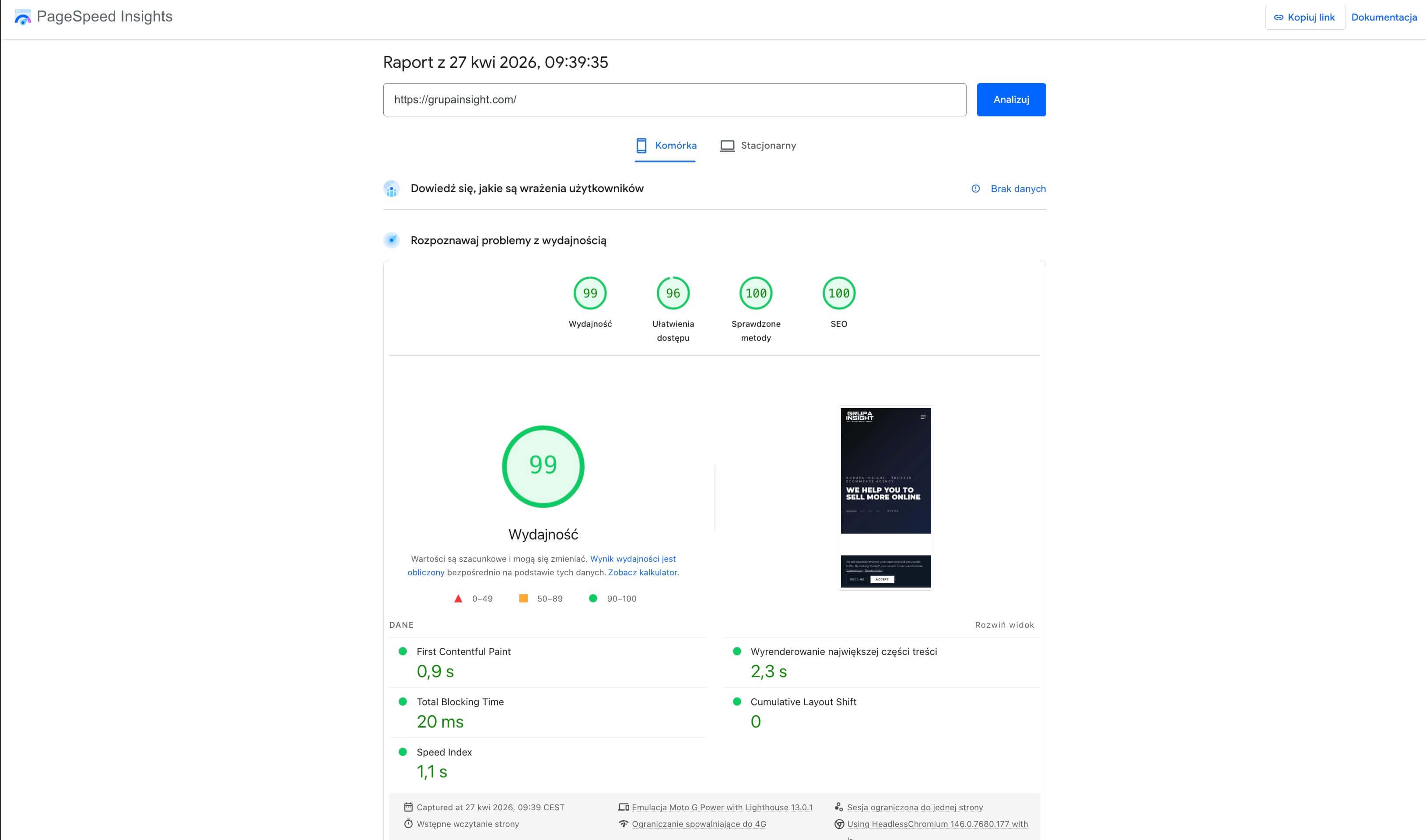 grupainsight.com — Google PageSpeed Insights mobile score (April 2026)
after migration from WordPress to Strapi + Next.js
grupainsight.com — Google PageSpeed Insights mobile score (April 2026)
after migration from WordPress to Strapi + Next.js - LCP: reduced to under 2.5s on mobile (Google's "good" threshold is <2.5s)
- TBT: 0ms — JavaScript no longer blocks rendering
The performance improvement was not the result of micro-optimizations. It came from three architectural changes:
- static generation (SSG) replacing dynamic rendering
- elimination of page builder overhead
- optimized asset delivery via Next.js (images, scripts, caching)
This is not a one-off case. Across multiple client projects, similar migrations from WordPress-based architectures to headless setups have consistently resulted in faster load times, improved Core Web Vitals, and measurable conversion rate increases (typically 15–25%).
For context: a typical WordPress site with Elementor or Divi scores 50–70 on mobile PageSpeed, with LCP often between 3–5s and TBT above 200ms.
This pattern repeats across projects — performance gains come from architecture, not from the CMS itself.
Summary
Headless CMS is not about flexibility — it is about architecture.
Strapi and Payload are winning not because they have more features, but because they fit modern API-first, performance-driven, and AI-ready systems.
For teams building with Next.js and TypeScript, the choice is clear:
- Strapi for content-heavy platforms with strong editorial needs
- Payload for applications where CMS is also part of the backend logic
However, the real decision is not which CMS to use.
It is whether your system architecture is built for performance, scalability, and AI integration.
In 2026, choosing a CMS is no longer a tooling decision — it is a system design decision.
Frequently Asked Questions
What is the difference between headless CMS and traditional CMS?
A traditional CMS like WordPress couples content management with frontend rendering — the same system manages both the database and the HTML output. A headless CMS manages only the content and exposes it via API, allowing any frontend framework to consume it. This gives developers full control over performance, design, and multi-channel content delivery.
Is Strapi free in 2026?
Yes — Strapi Community Edition is fully open-source and free to self-host. Strapi also offers a paid Cloud hosting option and an Enterprise tier with additional features. For most mid-market projects, the free self-hosted version covers all requirements.
What is the difference between Strapi and Payload CMS?
Strapi is more mature, easier to set up, and better suited for content-heavy platforms with non-technical editors. Payload is 100% TypeScript, more flexible at the code level, and works better when the CMS also needs to function as a full application backend. Both support Next.js natively. Strapi has a larger plugin ecosystem; Payload offers more architectural flexibility.
Is headless CMS better for SEO than WordPress?
Yes — when combined with Next.js static generation (SSG). A headless CMS + Next.js setup can achieve PageSpeed scores of 95–99 on mobile, compared to 50–70 for a typical WordPress site with page builders. Better Core Web Vitals scores directly improve organic search rankings.
How much does it cost to build a headless CMS project?
The CMS software (Strapi or Payload) is free for self-hosted deployments. Infrastructure costs for a typical mid-market project run €50–€300/month. Development costs depend on scope — a basic headless website can be delivered in 4–8 weeks, while complex e-commerce or SaaS platforms typically require 3–6 months.
What hosting is recommended for Strapi in 2026?
For most projects we recommend Railway, Render, or a VPS (DigitalOcean, Hetzner) for Strapi, combined with Vercel for the Next.js frontend. Strapi Cloud is a viable managed option. Avoid shared hosting — Strapi requires Node.js and at least 1GB RAM to run reliably.
Strapi vs Payload — which is better for Next.js projects?
Both integrate natively with Next.js. Strapi is the better choice for projects with content editors who need a polished admin UI and a large plugin ecosystem. Payload is better when the Next.js team wants full TypeScript control over the content model and needs the CMS to also handle authentication, file storage, and business logic.
Sources
This article was written by Rafał Grudowski, CEO of Grupa Insight — a digital agency and software house based in Warsaw, Poland, with 200+ projects delivered across 20 countries. Technology comparisons and use cases referenced reflect real implementation experience with Strapi, Payload, Contentful and Sulu across client projects. Pricing data is accurate as of Q1 2026 and subject to change. Last reviewed: April 2026.
— Editorial & Sources Policy