

Companies no longer compete only on pages. Increasingly, they compete on how well their knowledge can be understood, retrieved, summarized and attributed by AI systems.
Systems such as Google AI Overviews, ChatGPT Search and Perplexity do not only rank pages — they interpret, summarize, compare and retrieve information from multiple sources simultaneously.
This changes something important: visibility is no longer based only on rankings. It increasingly depends on how understandable, structured and correctly attributable the knowledge published by a company is.
And this is where layered knowledge architecture becomes important.
From content marketing to knowledge architecture
For years, most SEO strategies focused on landing pages, keyword targeting, blog content and backlinks. This model still matters.
But AI systems work differently from traditional search engines. They add a layer of interpretation, synthesis and answer generation on top of classical search. They try to identify entities, understand relationships, reduce ambiguity, retrieve contextual information and generate summaries and answers.
A single article is often not enough anymore.
The problem is not only "having content." The problem is whether the information architecture of a website allows AI systems to understand what the company does, connect concepts, evaluate expertise, retrieve useful fragments and attribute information correctly.
What is a layered knowledge architecture?
A layered knowledge architecture is a structured model where different types of content serve different roles.
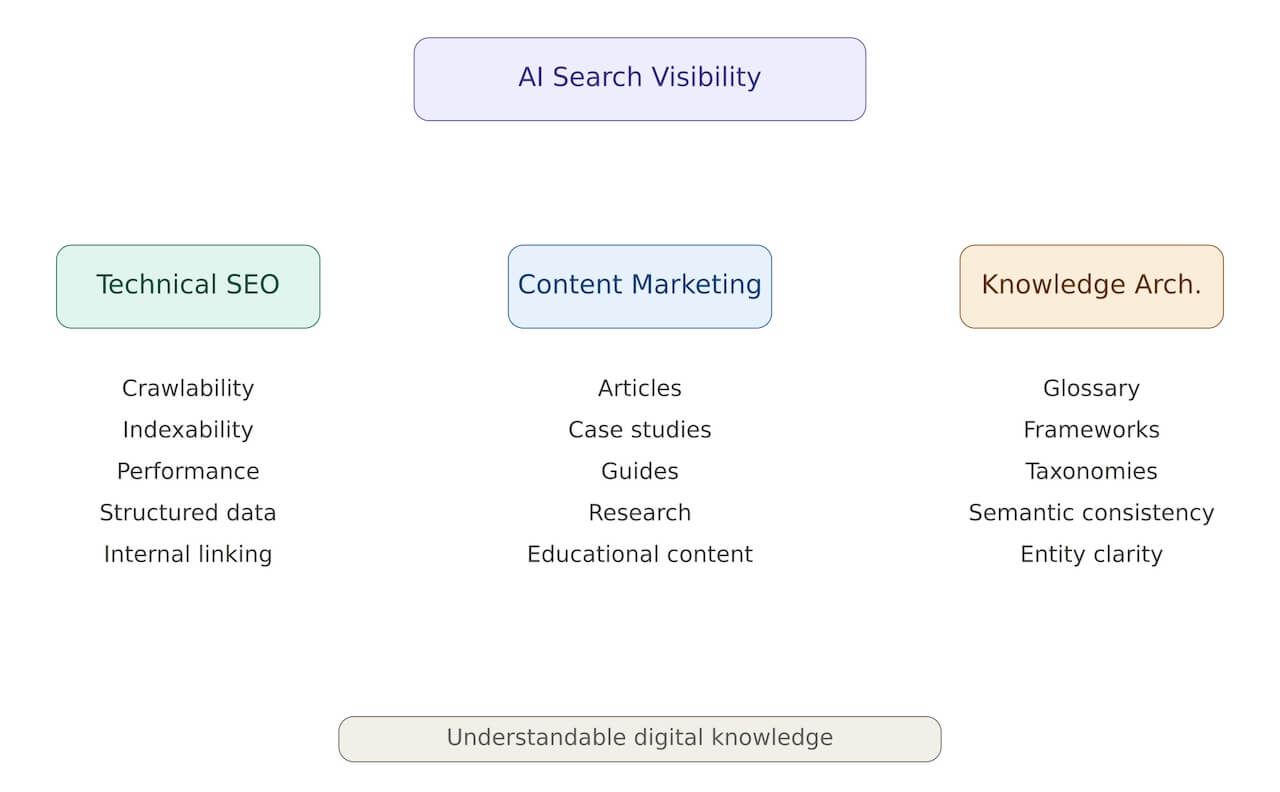 Not every page exists for rankings or conversions. Some pages exist to clarify concepts, reinforce entities, explain processes, organize expertise and support attribution and retrieval.
In practice, this means building multiple content layers instead of relying only on service pages and blog posts.
| Layer | Primary role | Example content | Business value |
|---|---|---|---|
| Conversion | Sales and leads | homepage, service pages, landing pages | explains the offer and drives contact |
| Authority | Proof of competence | case studies, guides, technical analyses | shortens client education and builds trust |
| Semantic | Reducing ambiguity | glossary, taxonomies, definitions | helps people and AI systems understand concepts |
| Framework | Proprietary methodology | evaluation models, standards, processes | builds differentiation and organizes expertise |
Layer 1: Conversion layer
This is the foundation of almost every business website.
It includes the homepage, service pages, landing pages and contact pages.
Its goal is straightforward: generate leads, explain the offer, support sales.
This layer is still critical. But for AI systems, it is usually not enough on its own. Service pages describe what a company does. They rarely demonstrate that it does it well.
Layer 2: Authority layer
This layer demonstrates expertise through evidence.
It typically includes case studies, implementation guides, technical articles, industry analyses and research content. The goal is not only traffic — it is to provide evidence: real projects, real decisions, measurable outcomes and operational knowledge.
The business case is direct: companies with a stronger authority layer typically require less sales effort to explain what they do. When AI systems can retrieve real evidence of a company's expertise, they do part of the pre-qualification work — before a prospect even makes contact.
Current documentation and independent testing suggest that AI Search visibility depends not only on rankings, but also on accessibility, contextual relevance, source attribution and the ability of systems to retrieve clear, structured information.
For companies operating as software houses, e-commerce businesses, consulting firms, B2B service providers and technical industry players, this layer becomes increasingly important.
Layer 3: Semantic layer
This is where websites begin moving beyond traditional content marketing.
The semantic layer may include glossaries, taxonomy systems, structured definitions, categorized knowledge hubs and entity-oriented content. Its purpose is to reduce ambiguity.
What exactly does the company mean by "AI Search"? What technologies connect to a specific service? How are concepts related?
This layer helps AI systems interpret information more consistently. It also helps human readers — especially in long B2B sales cycles where buyers do extensive research before making contact.
Not every company needs a semantic layer. But businesses with complex services, technical products, large content ecosystems or multilingual operations can benefit significantly from semantic organization.
The Grupa Insight AI Search Glossary with 20 defined terms is an example of this layer in practice — each definition acts as a standalone, structured knowledge object with a definition, mechanism, implementation and sources.
Layer 4: Framework layer
The framework layer is where companies move from publishing information to defining methodologies.
Examples include readiness models, evaluation frameworks, implementation standards, proprietary processes and operational systems.
This layer is not necessary for every business. But for companies competing through expertise — especially in consulting, software development, technical SEO and AI-related services — frameworks can become a major differentiator.
A framework helps organize expertise, terminology, priorities and evaluation logic. It also creates a stronger connection between articles, case studies, glossary entries and implementation guides.
In practice, it transforms a website from a collection of content into a structured knowledge system.
The Grupa Insight AI Search Readiness Framework is an example of this layer — a six-dimension evaluation model covering Entity Clarity, Content Architecture, Structured Data, Topical Authority, Trust Signals and Technical Accessibility.
When does a layered knowledge architecture make business sense?
This model is not necessary for every company. It makes the most sense when a company sells complex services, operates in a long decision cycle or needs to educate the market before selling.
In practice, this particularly applies to companies that:
- offer technology, consulting or B2B services,
- have a complex sales process with multiple touchpoints,
- need to explain differences between similar services or technologies,
- operate in multiple language markets,
- want to build visibility not only in Google but also in AI Search systems,
- need to reduce dependence on single landing pages and paid campaigns.
In this context, knowledge architecture is not an addition to SEO. It becomes part of the sales, positioning and communication scaling strategy.
How to start building a layered knowledge architecture?
The best starting point is not creating new content — it is auditing what already exists.
The first step is checking whether the site has a clear conversion layer: whether the offer, services and contact path are understandable.
The second step is evaluating the authority layer: whether the company shows real projects, decisions, results and operational knowledge.
The third step is organizing concepts: whether key terms, services, technologies and processes are named consistently across the entire site.
Only then does it make sense to build a glossary, frameworks, implementation guides or research sections.
In practice, a good knowledge architecture does not start with "how much content to publish?" but with: "what do AI systems and potential clients need to understand to correctly identify our expertise?"
Current AI Search systems appear to prefer interpretable content
One of the biggest misconceptions about AI Search is that visibility comes from producing more content faster.
Current AI Search systems appear to prefer content that is easy to interpret, contextually consistent and technically accessible. This is why architecture matters — not as a guarantee of visibility, but as a reduction of barriers for systems that try to understand and attribute expertise correctly.
A well-organized knowledge ecosystem makes it easier for systems to discover information, interpret meaning, retrieve relevant fragments, connect related concepts and attribute expertise correctly.
At the same time, crawler access alone does not guarantee visibility or citation. AI retrieval systems still behave inconsistently and remain difficult to predict precisely. The goal is not to manipulate a model — it is to reduce ambiguity so that when a system retrieves content, it can do so accurately.
This is not only about SEO
A layered knowledge architecture has benefits far beyond search visibility. It also helps organize company expertise, improve onboarding, simplify sales communication, support content scalability, clarify positioning and create reusable knowledge assets.
In many organizations, content problems are actually knowledge organization problems. AI Search simply makes those weaknesses more visible.
The next stage of digital visibility
Traditional SEO focused on pages. AI Search increasingly focuses on entities, relationships, expertise, attribution and contextual understanding.
This does not mean traditional SEO is obsolete. It means digital visibility is becoming more architectural.
Companies that treat their website as a structured knowledge system — not only a marketing channel — may gain a long-term advantage as AI-powered search evolves.
Frequently Asked Questions
Does every company need a layered knowledge architecture? No. A local restaurant or simple service business does not need a glossary, frameworks or semantic taxonomy. The layered model makes the most sense for companies with complex services, long B2B decision cycles, multiple integrations, multilingual markets or strategic AI Search visibility goals. The more a company needs to educate the market before selling, the more it benefits from structured knowledge layers.
When do glossaries and frameworks make business sense? When your company sells something that requires explanation before a client makes contact. Glossaries reduce the cognitive load of understanding your domain — they answer "what does this company mean by X?" before a prospect picks up the phone. Frameworks signal that you have a methodology, not just an opinion. Together, they move a website from a marketing channel to a knowledge system that does pre-qualification work on your behalf.
Will AI Search replace traditional SEO? No. AI Search systems still rely on many classical SEO signals — crawlability, content quality, information structure and source authority. What changes is how information is interpreted and presented. Ranking position still matters, but so does the ability of a system to understand, connect and attribute knowledge. The two disciplines complement each other rather than compete.
Does more content mean more AI Search visibility? Not necessarily. Current AI Search systems appear to prefer content that is easy to interpret, contextually consistent and technically accessible — not content that is simply high in volume. A well-structured cluster of ten interconnected pieces will likely outperform fifty isolated articles on unrelated topics. Architecture matters more than volume.
How do you start building an authority layer? Start by auditing what already exists. Identify completed projects that had measurable outcomes — then document the challenge, the approach and the result. Add the technical decisions and the stack. Publish that as a case study, not a testimonial. Authority comes from specificity: named clients, real numbers, documented decisions. Generic "we delivered results" content does not build authority layers.
Does AI Search require new technology? Not necessarily. Most of what makes a website AI Search ready — structured data, clean HTML, fast server response, consistent entity naming, well-organized content — is achievable on existing technology stacks. The gap is usually not technological but architectural: how content is organized, interconnected and described. A WordPress site with strong content architecture can outperform a headless Next.js build with thin, unstructured content.
How do you measure the effects of AI Search readiness? Through a combination of signals: referral traffic from chatgpt.com in analytics, branded query trends in Google Search Console, monthly prompt tests across ChatGPT, Perplexity and Google AI Overviews, and citation frequency tracking. No single metric captures AI Search visibility completely — the measurement framework needs to combine owned analytics data with systematic prompt testing and external mention monitoring.
Sources
- Google Search Central — AI features and your website
- Google Search Central — AI optimization guide
- Google Search Central — Introduction to structured data
- Google Search Central — Organization structured data
- OpenAI — Overview of OpenAI Crawlers
- OpenAI — Introducing ChatGPT Search
- Perplexity — PerplexityBot and robots.txt
- Google Search Central — FAQ structured data
This article reflects Grupa Insight's operational approach to AI Search readiness based on client implementations, direct testing and current documentation from Google, OpenAI and Perplexity. The AI Search landscape evolves rapidly — specific crawler behaviors and citation patterns may change. Last updated: May 2026.
— Editorial & Sources Policy