
Generative Engine Optimization is becoming the new SEO buzzword - and for good reason. AI-powered search systems are changing how visibility works, and the industry needs new frameworks to understand optimization beyond traditional rankings.
But GEO is often interpreted too narrowly.
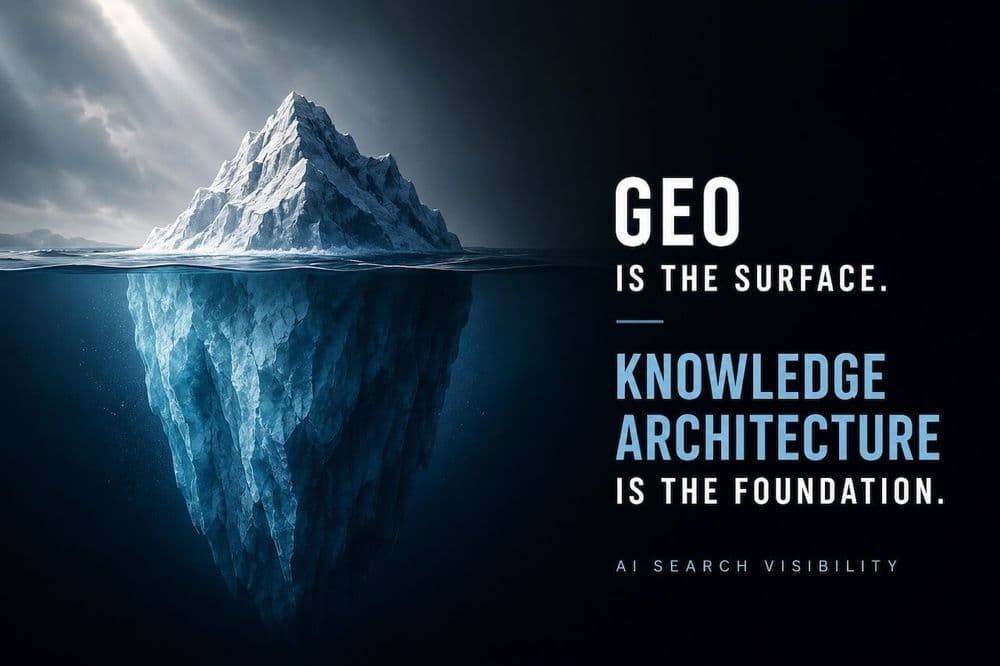
Most GEO discussions focus on the surface layer: content formatting, schema markup, llms.txt, crawler access and prompt testing.
These elements matter. But they do not solve the deeper problem.
The deeper problem is knowledge architecture. That is why we treat GEO as one layer of AI Search Readiness - not as the whole strategy.
Because AI Search visibility does not depend only on whether your content is optimized. It depends on whether an AI system can understand who you are, what you know, why you are credible and how your expertise connects across the web.
What most GEO discussions focus on
Most GEO content concentrates on a predictable checklist:
Adding FAQ sections and structured data. Writing longer, more comprehensive content. Implementing llms.txt. Allowing AI crawlers in robots.txt. Monitoring brand mentions in AI search outputs.
These are valid starting points. They reduce technical barriers and improve content structure. But they address the surface layer of AI Search readiness - not its foundations.
A website can have perfect schema markup, a well-formatted llms.txt and content that answers every question - and still be invisible in AI-generated answers.
The reason is almost always the same: the knowledge structure underneath is ambiguous, inconsistent or incomplete.
The deeper problem: knowledge architecture
AI-powered retrieval systems do not work like keyword-based search engines. They do not simply match a query to a page. They interpret, synthesize, compare and attribute.
This means they need to answer questions that go beyond "does this page contain the right keywords?"
They need to understand: who is this source, what does it do, what domain does it cover, who stands behind the content, how does it relate to other entities, and is it consistent across multiple touchpoints?
These are not content questions. They are knowledge architecture questions.
| What GEO typically addresses | What knowledge architecture addresses |
|---|---|
| Schema markup and structured data | Entity clarity and brand disambiguation |
| Content formatting and FAQ structure | Information architecture across the entire site |
| llms.txt and crawler access | Semantic consistency across pages, profiles and external sources |
| Prompt testing and citation monitoring | Topical authority built across interconnected content layers |
| Meta descriptions and page titles | Author attribution, credentials and E-E-A-T signals |
This is the gap many GEO checklists miss.
They optimize individual assets. Knowledge architecture organizes the entire system behind those assets: the brand entity, the content layers, the authors, the relationships, the trust signals and the technical paths through which AI systems access the information.
In other words, GEO improves the surface. Knowledge architecture makes the source understandable.
Six dimensions that GEO alone does not cover
This is where AI Search optimization needs to become more systematic.
Instead of asking only "is this page optimized for GEO?", we ask a broader question: can an AI-powered search system understand, trust and reuse this website as a reliable source?
At Grupa Insight, we evaluate AI Search readiness across six dimensions. GEO - in its most common form - addresses parts of two of them. The other four are largely ignored in standard GEO discussions.
Entity clarity. Is your brand consistently and unambiguously defined on your website and in trusted external sources? AI systems must identify who you are before they can cite you. A company with inconsistent name formats, mismatched NAP data across directories, no Organization schema and no sameAs links is an ambiguous entity - regardless of how well its content is formatted.
Content architecture. Is content structured so that AI systems can extract clear, standalone answers from each section? This goes beyond adding FAQ sections. It means definitional paragraphs, numbered processes, comparison tables and retrieval-oriented formatting throughout the entire site - not just on a few optimized pages.
Structured data. Does schema markup make pages self-describing? Article schema with named authors and dates, Person schema on author pages with links to published work, FAQPage schema, BreadcrumbList sitewide - these are not optional extras. They are the signals AI systems use to understand authorship, dating and organizational relationships without parsing prose.
Topical authority. Does the site cover its target topic with sufficient depth and breadth? AI systems tend to favor sources with demonstrated expertise across a domain - not isolated pages. A single well-optimized article is not enough. A content cluster covering a topic from multiple angles - definitions, guides, comparisons, case studies, frameworks - is significantly more likely to be retrieved and cited consistently.
Trust signals. Does the content demonstrate that a named expert with verifiable credentials stands behind it? Generic, unattributed content is harder to attribute and trust - for both human readers and AI systems. Named authors, verifiable credentials, accurate publication dates, editorial notes and links to external presence are all part of this dimension.
Technical accessibility. Can AI Search crawlers access, fetch and interpret the content? OAI-SearchBot and PerplexityBot must be allowed, core content must be available as indexable HTML, canonical URLs must be clean and consistent. This is where standard GEO advice starts - but it is only the foundation, not the full picture.
Why the surface layer is not enough
Here is a useful way to think about it.
Imagine two companies in the same industry. Both have implemented schema markup, both have FAQ sections, both have allowed AI crawlers in robots.txt and both have published llms.txt files.
Company A has one well-optimized service page and three recent blog posts. Its founder is named on the about page but has no linked author profile, no LinkedIn and no published articles. Its service descriptions are inconsistent across pages and external profiles.
Company B has a content cluster of twelve interconnected pieces covering its core service from multiple angles - definitions, implementation guides, comparisons, case studies and a proprietary evaluation framework. Its authors have dedicated bio pages with credentials, LinkedIn links and a track record of published work. Its entity is consistently named and described across its website, Google Business Profile, Clutch profile and industry directories.
Both companies have done the GEO checklist. But only one has built the knowledge architecture that AI systems need to confidently retrieve and cite a source.
GEO as part of a bigger shift
This is not an argument against GEO. GEO as a term captures something real: AI-powered search systems are changing how visibility works, and optimization for those systems requires different thinking than classic keyword SEO.
But GEO in its current form describes a set of tactical actions, not a strategic framework.
The shift that matters is architectural. It is about treating a website not as a collection of pages optimized for specific keywords, but as a structured knowledge system that allows AI systems to understand, retrieve and attribute a company's expertise correctly.
This shift requires thinking about:
How entities are defined and disambiguated. How content layers connect and reinforce each other. How expertise is demonstrated and attributed. How information is organized so that it can be extracted at multiple levels of granularity. How technical accessibility is maintained not just for Google but for the full ecosystem of AI-powered retrieval systems.
GEO is a useful entry point into this conversation. But it is not the destination.
What this means in practice
For companies that want to build long-term AI Search visibility - not just pass a GEO checklist - the starting point is an honest assessment of knowledge architecture, not a list of tactical fixes.
The questions worth asking are:
Is our brand clearly defined as a named entity with consistent information across all touchpoints? Can AI systems understand our expertise from our content alone - without relying on our own claims? Do we have enough interconnected content to demonstrate topical authority in our domain? Are our authors identifiable, creditable and linked to their work? Is our technical infrastructure accessible to the full range of AI Search crawlers?
If the answer to any of these is no, the problem is not that the GEO checklist is incomplete. The problem is that the foundation is missing.
Before optimizing for GEO, check the foundation
If your website is not clearly understood as a source, GEO tactics will only improve the surface.
Our AI Search Readiness Framework helps evaluate whether your brand, content, authorship, structured data and technical setup are ready to be discovered, interpreted and cited by AI-powered search systems.
Explore the AI Search Readiness Framework
Frequently Asked Questions
Why do GEO checklists often fail? GEO checklists often fail because they improve visible elements of a page without solving the underlying source problem. AI-powered search systems need to understand the brand entity, the author, the topic, the relationships between pages and the consistency of information across trusted sources. If that foundation is weak, better formatting or schema markup alone will not create durable AI Search visibility.
Is GEO the same as AI Search Optimization? GEO (Generative Engine Optimization) is one of several terms used to describe optimization for AI-powered search systems - alongside AEO, LLMO and AI SEO. None has become a universally accepted standard. At Grupa Insight, we treat GEO as part of a broader AI Search Readiness strategy that covers entity clarity, knowledge architecture, authority signals and technical accessibility - not just content formatting and schema markup.
What is the difference between GEO and AI Search Readiness? GEO typically refers to tactical content and technical optimizations aimed at improving visibility in AI-generated answers. AI Search Readiness is a broader concept that includes GEO but also addresses the underlying knowledge architecture - how a brand is defined as an entity, how content layers connect, how expertise is attributed and how consistently the brand is described across all touchpoints. GEO without AI Search Readiness is optimization without foundation.
Does GEO replace traditional SEO? No. Traditional SEO signals - crawlability, content quality, internal linking, backlinks, page performance - remain relevant for AI Search systems. What changes is the additional layer of interpretation, synthesis and attribution that AI systems perform on top of classical search signals. GEO and AI Search Readiness extend traditional SEO rather than replace it.
Can structured data alone improve AI Search visibility? Structured data helps AI systems interpret page content more accurately - but it is one signal among many. A page with perfect schema markup but no topical authority, no named author and no consistent entity definition will still struggle in AI Search. Structured data is necessary but not sufficient.
How do you measure AI Search visibility? Through a combination of signals: referral traffic from chatgpt.com in analytics, branded query trends in Google Search Console, monthly prompt tests across ChatGPT, Perplexity and Google AI Overviews, and citation frequency tracking across AI tools. No single metric captures AI Search visibility completely - the measurement framework needs to combine owned analytics data with systematic prompt testing and external mention monitoring.
What is the first step toward AI Search Readiness? Start with an entity clarity audit: check whether your brand is consistently defined across your website, Google Business Profile, LinkedIn, Clutch and industry directories. Then assess your content architecture: does each major section of your site have definitional paragraphs, named authors and structured data? Only after the foundation is solid does it make sense to focus on more advanced GEO tactics like llms.txt and prompt optimization.
Does AI Search Readiness require a complete website rebuild? Not necessarily. Most of what makes a website AI Search ready - entity schema, clean HTML, consistent naming, well-organized content - is achievable on existing technology stacks including WordPress. The gap is usually not technological but architectural: how content is organized, interconnected and described. A well-structured WordPress site can outperform a headless Next.js build with thin, unstructured content.
Sources
- Google Search Central - AI features and your website
- Google Search Central - AI optimization guide
- OpenAI - Overview of OpenAI Crawlers
- Perplexity - PerplexityBot and robots.txt
- Aggarwal et al. - GEO: Generative Engine Optimization (arxiv.org, 2023)
- Grupa Insight - AI Search Readiness Framework
- Grupa Insight - Generative Engine Optimization (GEO)
- Grupa Insight - Why AI Search Requires a Layered Knowledge Architecture
This article reflects Grupa Insight's operational approach to AI Search readiness based on client implementations, direct testing and current documentation from Google, OpenAI and Perplexity. The AI Search landscape evolves rapidly - specific crawler behaviors and citation patterns may change. Last updated: May 2026.*
— Editorial & Sources Policy