
Many companies still measure search visibility using a model built for a different era:
keyword rankings, organic clicks, impressions in Google Search Console, sessions from traditional SERPs.
Those metrics still matter. But in 2026, they no longer capture the full picture.
Users increasingly discover brands through AI answer interfaces such as Google AI Overviews, ChatGPT Search and Perplexity. These journeys often end without a click — yet they shape awareness, preference and purchase intent just as effectively as traditional search.
This creates a measurement problem most dashboards are not built to solve.
Your brand may be influencing decisions even when no click is recorded.
The real question is no longer: how many clicks did we get? It is: how visible are we across AI-assisted search journeys — and how do we track something that does not always leave a clean data trail?
Why traditional SEO metrics are no longer enough
For years, search measurement focused on rankings, CTR, organic sessions and conversions from traditional SERPs. Useful metrics — but increasingly incomplete.
A user may now ask ChatGPT for the best CRM for small business, receive five recommended brands, search one brand directly later and convert through branded traffic or a direct visit. In analytics, that conversion may appear as direct traffic, branded search or a returning user. The original AI discovery moment is invisible.
This attribution gap is not a bug. It is a structural feature of how AI-assisted discovery works. Waiting for perfect attribution means missing the shift entirely.
What AI Search visibility actually means
Visibility in AI Search is not one metric. It is a layered concept with five distinct dimensions:
1. Mention visibility How often your brand appears in AI-generated answers — whether cited, named or described.
2. Citation visibility How often your website is referenced as a source. A brand can be mentioned without its website being cited — a meaningful distinction for authority building.
3. Recommendation visibility How often your company appears in "best tools", "top agencies" or "recommended providers" outputs — the category-level prompts that shape purchase consideration before users ever visit your site.
4. Entity recognition Whether AI systems clearly understand who you are, what you do, where you operate and what category you belong to. Poor entity clarity means inconsistent or absent mentions even when your offer is directly relevant.
5. Demand creation Whether users later search for your brand after AI exposure — the downstream signal that AI influence actually occurred.
AI visibility should be measured as influence plus discoverability, not only as clicks.
Core metrics to track
Branded search growth
One of the most accessible and consistent early signals — and one most businesses already have in Google Search Console.
Track brand name queries, founder name queries, company and service queries, and misspellings and variants. Rising branded demand while organic traffic is flat often suggests off-SERP awareness is increasing.
Direct traffic and returning user trends
Not all direct traffic comes from AI Search, but some AI discovery journeys end there — particularly for users introduced to a brand through a conversational interface who later search directly.
Monitor direct sessions, returning users, assisted conversions and time lag before conversion in GA4. A rising share of direct and branded returning traffic alongside flat referral traffic can indicate growing off-SERP influence.
AI mention tracking — manual and sampled
There is currently no fully automated, reliable solution for tracking brand mentions across all AI interfaces. The practical approach is structured manual sampling on a regular schedule.
Run recurring prompts across ChatGPT Search, Perplexity, Gemini and Google AI Overviews using commercial-intent queries relevant to your category:
- best software house in Poland
- top SEO agency for ecommerce in Europe
- who specialises in AI Search optimization
- Next.js agency Warsaw
Track whether you appear, the order and context of mention, whether your website is cited as a source and how competitors are referenced. Tools such as Otterly.ai and Profound offer partial automation for LLM visibility tracking — though coverage and reliability vary across platforms.
Referral traffic from AI tools
Where visible in GA4, track referral sources including chat.openai.com, chatgpt.com and perplexity.ai. This data is often incomplete — many AI-assisted visits arrive without referrer data — but provides a directional signal worth monitoring monthly.
Assisted conversions and path analysis
Many AI journeys are multi-touch. Tracking first visit source versus conversion source, branded return visits and path length before sale helps quantify how often AI-influenced users eventually convert through other channels.
Mini case study: early entity signals after migration
In February 2026, Grupa Insight migrated its website to Next.js 14 + Strapi and implemented entity SEO from the ground up — Organization schema, Service schema, named authorship, hreflang across EN/PL/DE and tightly structured topical clusters.
Within 10 weeks, several signals appeared in GSC and GA4 that we had not seen at this scale previously:
- branded queries including "grupa insight", "group insight" and "insight agency" began appearing organically
- direct traffic share increased relative to referral
- returning user rate rose
- impression volume in the first post-migration quarter approached roughly half of total impressions from the prior 11-month WordPress period
We cannot isolate entity SEO as the sole cause — technical improvements, new content and multilingual expansion all contributed. But the pattern is consistent with improved entity recognition driving early demand signals before significant organic ranking growth occurred.
This is the directional sequence we expect to see when entity clarity improves: branded demand first, organic ranking growth later.
The revenue layer: why AI visibility has commercial consequences
Most AI Search discussions focus on impressions and mentions. The more important question for business owners is: does AI visibility affect revenue outcomes?
Based on patterns we consistently observe across B2B client work at Grupa Insight:
Branded leads close 1.5–2x faster than cold traffic. When a prospect already knows the brand, understands its positioning and has formed a view before the first conversation, trust is established before the sales process begins. Less education required, shorter decision cycle.
CAC for branded and returning users is measurably lower than for cold acquisition — particularly in B2B services with longer decision timelines. The marketing investment that created the original AI-assisted awareness is rarely captured in last-click attribution, making branded CAC appear artificially low while its true source goes unmeasured.
Sales cycles are shorter for prospects who encountered the brand earlier. Clients who found Grupa Insight through content, case studies or earlier site visits before making contact typically require fewer exploratory conversations and arrive with clearer intent.
Lead quality is higher. Higher intent, better fit, fewer "just researching" enquiries.
These patterns suggest that AI visibility — even when it produces no direct click — can materially affect the efficiency of the sales funnel downstream. Measuring only clicks systematically undercounts this value.
Many businesses are spending heavily on paid acquisition while their branded lead quality and conversion rates quietly signal that AI-assisted awareness is already doing commercial work — unattributed and unmeasured.
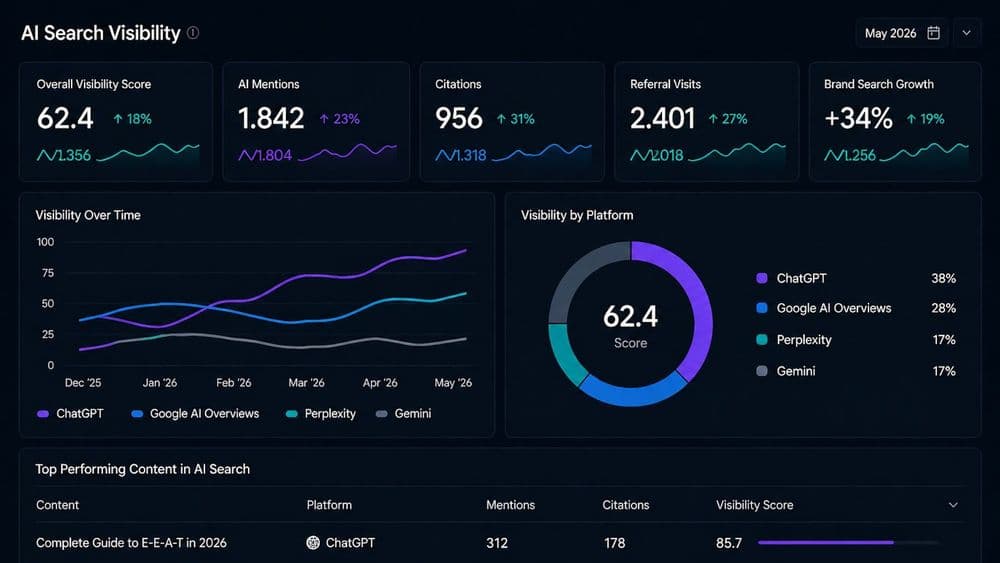
A practical AI Search dashboard
A monthly visibility dashboard should track four signal categories:
Demand signals
- branded impressions and clicks (GSC)
- direct traffic trend (GA4)
- returning user rate
Visibility signals
- AI mentions via manual prompt sampling
- citation frequency across platforms
- category prompt presence
Commercial signals
- branded conversion rate
- assisted conversions
- lead quality from branded traffic
Entity signals
- knowledge panel presence
- review volume and recency
- brand mention growth
- schema markup coverage
No single metric is sufficient. The value is in tracking directional movement across all four categories over time — and connecting visibility trends to commercial outcomes where possible.
The attribution problem — and a practical response
Perfect attribution for AI Search journeys does not currently exist. AI interfaces do not consistently pass referrer data, conversion paths are longer and less linear, and much AI influence happens in sessions that never touch your analytics.
The practical response is not to wait for better data. It is to build a blended visibility model:
- Hard data: GSC branded queries, GA4 direct traffic, referral from AI tools
- Sampled data: manual prompt tracking, citation frequency, competitor benchmarking
- Proxy data: review growth, brand mention volume, assisted conversion trends, lead quality signals
The working formula:
AI visibility = mentions + branded demand + assisted conversions + discoverability + source authority
None of these components is perfectly measurable. Together, they provide a directional picture significantly more useful than clicks alone.
Why rankings alone can now mislead
A company can rank fourth organically for a valuable keyword and still lose effective visibility if an AI Overview answers above the organic results, competitors are cited first in generative answers, or users never scroll to the organic listings.
Conversely, a brand with modest rankings may gain significant market attention if consistently recommended in AI interfaces — building branded demand that eventually converts through direct or branded search.
Many businesses spending significant budgets on content SEO are still optimising for a metric that no longer tells the whole story. Publishing large volumes of generic content before understanding how AI discovery works is one of the most common visibility mistakes in 2026 — not because content is wrong, but because the measurement model is incomplete. Teams celebrate rising organic impressions while the actual discovery channel shifting beneath them goes untracked.
How to improve AI Search visibility
Measurement only matters if paired with action. The levers most consistently associated with stronger AI Search presence include:
- entity SEO and structured data implementation
- clear niche positioning with consistent messaging
- expert-led content with named authorship
- comparison and category pages matching recommendation-style prompts
- PR, citations and off-site brand mentions
- branded demand generation through thought leadership
- consistent identity across all digital assets
AI systems appear to reward clarity, authority and recognizability — the same signals that support strong E-E-A-T in traditional search. Exact retrieval mechanisms are not publicly disclosed, but the correlation between entity clarity and AI mention frequency is increasingly observable in practice.
Common measurement mistakes
Measuring only clicks AI influence often happens before the click. Click-only measurement systematically undercounts AI-assisted discovery.
Ignoring branded search growth Often the strongest early signal of growing AI visibility — and one most companies overlook because it does not appear in keyword ranking reports.
Treating all AI platforms as one channel ChatGPT Search, Perplexity, Google AI Overviews and Gemini behave differently, cite sources differently and serve different user intents. Prompt testing should cover major platforms separately.
Expecting perfect attribution It usually does not exist. Directional indicators are sufficient for most strategic decisions — waiting for perfect data means delaying action.
Chasing mentions without commercial relevance Visibility without relevance has limited business value. The goal is presence in the right category conversations, not maximum mention volume.
30-day AI Search measurement checklist
Week 1 — Baseline
- Create branded query baseline in Google Search Console
- Segment direct traffic in GA4
- List 10–15 target category prompts relevant to your business
- Identify key competitors to benchmark against
Week 2 — Sampling
- Manually test prompts across ChatGPT Search, Perplexity, Gemini and Google AI Overviews
- Record mentions, citations, order and context
- Note competitor presence in same prompts
- Check referral traffic from AI tools in GA4
Week 3 — Commercial signals
- Review assisted conversions and path analysis
- Analyse branded conversion rate trend
- Inspect returning visitor patterns and time-lag reports
Week 4 — Action and iteration
- Identify visibility gaps from prompt sampling
- Prioritise entity and content fixes
- Update schema markup where relevant
- Set monthly repeat schedule
Summary
Search measurement is evolving faster than most dashboards.
Clicks, rankings and organic traffic still matter — but they no longer capture the full customer journey in an AI-assisted search environment. The brands winning in 2026 may not always be the ones with the most clicks. They may be the brands most often remembered, recommended and searched for later — brands whose AI visibility builds demand that converts through channels traditional analytics struggles to attribute.
Building a blended measurement model now — even an imperfect one — puts you ahead of most competitors still optimising for a metric that no longer tells the whole story.
Frequently Asked Questions
Can AI Search visibility be measured precisely? Not with current tools. The practical approach is a blended model combining GSC branded data, GA4 direct traffic trends, manual prompt sampling and assisted conversion analysis. Directional indicators are more useful than waiting for perfect attribution.
Is branded search growth a reliable signal? One of the most accessible and consistent early indicators. Rising branded demand while organic traffic is flat often suggests growing off-SERP awareness — though multiple factors can contribute.
Do traditional rankings still matter? Yes — but rankings alone are no longer sufficient. A brand can rank well organically and still lose effective visibility if AI Overviews dominate the SERP or competitors are consistently cited first in generative answers.
Which tools help track AI mentions? Manual prompt tracking across ChatGPT Search, Perplexity, Gemini and Google AI Overviews is currently the most reliable approach. Otterly.ai and Profound offer partial automation. GA4 referral traffic from AI sources provides additional signal.
What is the best single KPI for AI Search? There is no single sufficient KPI. A blended model tracking branded demand, direct traffic trends, AI mentions and assisted conversions gives a more complete picture than any individual metric.
How often should AI visibility be measured? Monthly tracking of the full dashboard, with weekly review of branded query trends in GSC as a leading indicator. Quarterly deeper analysis of prompt sampling and category presence.
Sources
- Google Search Central – How Google Search Works
- Google Search Central – Search Quality Evaluator Guidelines
- Google Analytics 4 – Attribution documentation
- Perplexity AI – Public documentation
- OpenAI – ChatGPT Search
- Industry research on zero-click search behaviour and AI-assisted discovery (BrightEdge, SparkToro, 2025)
This article was written by Rafał Grudowski, CEO of Grupa Insight, a Warsaw-based digital growth and technology company with 300+ projects delivered across 20 countries. The measurement framework, revenue patterns and entity signal observations referenced in this article reflect practical experience from Grupa Insight's own domain tracking and B2B client work across digital strategy and AI Search Optimization projects. References to AI Search behaviour, attribution models and platform dynamics are based on publicly available documentation from Google, OpenAI and Perplexity, combined with observable patterns in Google Search Console and GA4 data. All claims about AI retrieval mechanisms are presented as directional observations, not confirmed ranking factors. Last reviewed: April 2026.
— Editorial & Sources Policy