
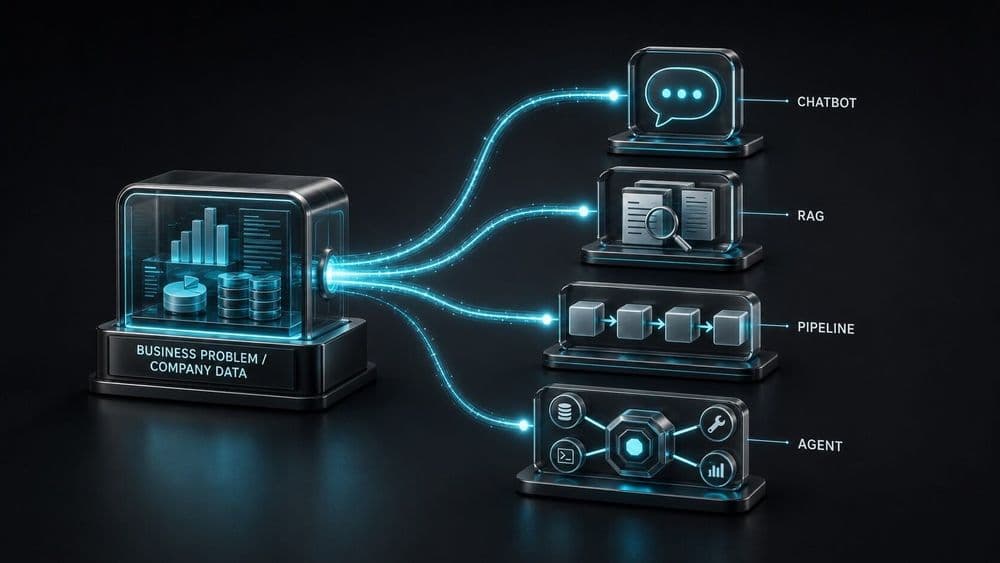

Chatbot, RAG, LLM pipeline, and AI agent are not four versions of the same solution. They may use similar models, but they perform entirely different tasks.
First, you need to determine whether the system should respond, retrieve, process, or act. Only then is it worth choosing a model, a vector database, and the rest of the technology stack.
It usually starts with a chatbot
More and more conversations about AI implementation begin the same way:
- We want a chatbot.
Sometimes the company genuinely needs a chatbot. After a few questions, however, it often turns out that the system is expected to read documents, check current data in the ERP, analyze information from multiple sources, remember previous decisions, or carry out multi-step workflows.
At that point, we are no longer talking about a simple chatbot.
The problem is that chatbot, RAG, LLM pipeline, and AI agent are all lumped together today. They can all use a language model. They can all have an interface that looks like a conversation. From the user's perspective, they may even appear similar.
The difference starts deeper.
In the data they use. In the process they follow. In the tools they can access. And above all, in the level of responsibility we expect from them.
That is why, instead of starting with "which model should we choose?", it is better to answer a simpler question first:
Should the system respond, retrieve, process, or act?
A simple chatbot handles a specific scenario
The simplest bot does not need access to all of the company's knowledge. It does not need to understand every question a user might come up with.
It needs to do a defined job.
It can answer a few of the most common questions, help choose a service, collect contact details, walk the user through a form, or hand the conversation over to a human.
That can still be a good solution.
Not every process requires an elaborate AI architecture. If the range of questions is limited, answers change rarely, and a mistake carries no serious consequences, a simple bot will often be faster, cheaper, and easier to maintain.
The trouble starts when we expect it to answer based on hundreds of documents, a changing product catalog, or live data from internal systems.
At that point, a well-written prompt is no longer enough.
RAG gives the model access to company knowledge
RAG, or Retrieval-Augmented Generation, is often described as combining a language model with a document database.
That is true, but only partially.
The key point is that the model does not have to rely solely on the knowledge it acquired during training. Before generating an answer, the system searches the company's own sources and passes the relevant information as context.
Those sources can be documents, but also a SQL database, a product catalog, a CRM, an ERP, internal APIs, or several different systems at once.
The retrieval layer can work semantically - for example through a vector database - or deterministically, when the system runs a SQL query or fetches a specific value through an API.
In larger and more diverse knowledge bases, hybrid search is often used as well. It combines semantic similarity with traditional keyword matching for exact terms, proper names, product codes, or other identifiers.
In practice, the process looks roughly like this:
- the user asks a question,
- the system determines where to look for the answer,
- it retrieves the relevant information,
- it passes it to the model,
- the model generates an answer based on the retrieved data,
- the system can attach sources or supporting excerpts.
An assistant like this can answer questions about technical documentation, procedures, product offerings, regulations, or internal company knowledge.
In a well-designed system, however, it is not just about finding text that is semantically similar to the question.
Current stock levels are better fetched directly from the ERP. Prices from the system that is their source of truth. Documentation can be searched semantically, while relationships between entities sometimes require a graph or a structured query.
RAG does not automatically mean "PDFs plus a vector database."
It is a way of delivering the right context to the model. The retrieval method itself depends on the data and the question.
A good example is the BLUP-FLOCK system, where standard document search was not enough. The system needed to work with genealogical data and relationships across generations of animals, which required a custom context retrieval mechanism and a deterministic computation layer.
An LLM pipeline does not need to talk to anyone
Not all systems built on language models have a chat interface.
Sometimes the user does not want to talk to AI. They want the system to do the work and return a finished result.
An LLM pipeline can fetch a document, identify its type, extract the necessary information, validate it against rules, save the result in a CRM, and pass the case to the next stage of the process.
It can analyze RFPs, classify messages, organize product data, prepare summaries, or process content before publication.
The steps are usually predefined.
The model handles the part of the work that requires language understanding, but the overall process does not need to decide on its own what to do next. If a document has been correctly classified, it moves to step two. If not, the system triggers validation or hands the case to a human.
This is an important distinction.
A pipeline can use an LLM, but it does not have to be an agent.
An AI agent gets a role, memory, and tools
An agent begins where the system not only processes data along a single path, but has to assess the situation and choose the next step.
In our marketing agents, calling the model is the least interesting part.
The agent needs to know which company it works for. Know its goals, the history of previous decisions, and its constraints. Have access to the right data. Understand what it can touch and what it must not change.
For example, an agent might pull data from Google Ads and detect a significant increase in cost. But a change in a metric does not yet mean something has gone wrong.
The system can check whether demand has shifted, whether conversion counts have changed, whether traffic quality has dropped, or whether the landing page is underperforming. It can read previous recommendations and notice that a similar situation occurred a month earlier. Only then does it prepare its conclusion.
Not just:
CPC increased by 18%.
Rather:
CPC increased, but conversion volume remained stable. During the same period, the share of traffic from a more expensive product campaign grew. We do not recommend cutting the budget until the profitability of that product group has been verified.
This still does not mean the agent should change the campaign on its own.
It can prepare a recommendation, attach the data, determine a confidence level based on data quality, completeness, and consistency, and then pass the decision to a human.
Permissions to execute changes can be added later - only where the risk is controlled and an audit trail exists.
The model matters. But an agent only emerges when the model is surrounded by:
- a role,
- context,
- memory,
- tools,
- rules,
- permissions,
- monitoring,
- a history of decisions.
We use this kind of architecture in our system of agents that analyze Google Ads, GA4, and Search Console data. The agent does not just generate a report - it cross-references sources, evaluates data quality, records previous decisions, and creates recommendations that require human approval.
See the case study: AI Agents for Google Ads & SEO Intelligence.
When does an AI agent make business sense?
The mere fact that a process uses multiple systems or a language model does not mean you need to build an agent.
An agent may make sense when at least several of the following conditions are present at the same time:
- the decision requires combining information from multiple sources,
- the situation is ambiguous and cannot be captured in a single rule,
- experts regularly perform similar analyses but need to account for different context each time,
- response time affects revenue, costs, or service quality,
- the process ends with a recommendation or an action, not just generated text,
- the company can define which decisions the agent may make on its own and which require approval,
- there is a way to verify whether the agent's recommendations actually deliver results.
Connecting multiple data sources alone does not justify an agent. Sometimes a pipeline, a dashboard, or a well-written automation is enough.
An agent becomes justified when the greatest value lies not in collecting the data, but in interpreting it and choosing the next step.
Four different system roles
The easiest way to see the difference is to compare not the technologies themselves, but the roles they are meant to play in a process.
| Criterion | FAQ bot / simple chatbot | RAG assistant | LLM pipeline | AI agent |
|---|---|---|---|---|
| Primary task | Handle a limited scenario | Answer based on company data | Automated data processing | Analysis and multi-step action |
| Data | Prompt instructions, static answers or simple rules | Documents, APIs, SQL and retrieval | Source systems and files | APIs, memory, tools and context |
| Interface | Usually chat | Chat, search or API | Usually a background process | Chat, dashboard, email or background process |
| Output | Answer or redirect | Answer grounded in sources | Structured result | Insight, recommendation or action |
| Process variability | Low | Medium | Low to medium | High |
| Human oversight | Usually at exceptions | For high-risk answers | At errors and exceptions | For actions with significant impact |
Within a single system, these roles can of course overlap.
An agent can use RAG. A pipeline can include a retrieval step. A RAG assistant can look like a chatbot. A simple bot can escalate harder questions to a more advanced system.
It is not about choosing a single label.
It is about properly separating responsibilities.
Sometimes the best solution is still plain automation
The more people talk about agents, the easier it is to start building them everywhere.
That does not make sense.
If a process can be unambiguously described:
if A happens, do B,
it is usually best to write a simple rule.
Code will be cheaper, faster, easier to test, and more predictable than a language model.
An agent is useful when the situation is not clear-cut. When you need to combine information from several places, interpret what it means, form a hypothesis, or choose the next step.
The best systems we build today combine both approaches.
Data is fetched and validated deterministically. Thresholds, formats, and basic calculations stay in code. The model only comes in where interpretation is genuinely needed.
The rest stays in deterministic code, because code is cheaper, faster, and easier to test.
Not because we want to use AI less.
Because we want to use it where it adds value.
What drives cost?
There is no honest way to say that a chatbot will always be cheapest and an agent will always be most expensive.
A simple bot handling a few questions can cost very little. A chatbot running on an expensive model, serving thousands of long conversations a day, can be more expensive than an agent that runs once a week.
Cost depends on, among other things:
- number of model calls,
- context length,
- the model chosen,
- number of process steps,
- number of external tool calls,
- frequency of data synchronization,
- the retrieval and reranking approach,
- required response speed,
- monitoring and evaluation,
- human involvement,
- security and infrastructure requirements.
For RAG, there is the additional cost of preparing, indexing, and updating data. For pipelines, the volume of processed documents matters. For agents - the number of steps, sources used, and how often the agent runs.
A separate category is the cost of entry.
It includes data preparation, integration with existing systems, permissions configuration, building a test suite, designing constraints, handling edge cases, and deploying monitoring.
In the first phase of a project, the cost of entry can be significantly higher than the ongoing cost of model calls.
The cost of tokens alone is often not the largest line item.
More goes into data preparation, integration with existing systems, exception handling, and getting the solution to the point where it can be trusted in production.
The biggest risk appears before choosing technology
It is easy to assume that the biggest mistake will be choosing RAG instead of an agent, or a pipeline instead of a chatbot.
More often, the problem starts earlier.
The company does not know exactly which process it wants to improve. There is no single source of truth for the data. Documents are outdated. Two systems show different values. No one has established who is responsible for the output or what the system should do when it does not have enough information.
Problems with data quality, availability, and governance are among the most common reasons AI projects stall.
But they are not the only ones.
Equally important can be:
- no clearly defined business value,
- the cost of maintaining the solution,
- underestimating integration effort,
- lack of monitoring,
- no procedure for incorrect answers,
- too broad a scope for the first version,
- no person responsible for the system's operation.
You can build a technically correct chatbot, RAG system, or agent that nobody needs.
That is why a project should start not with a model demo, but with a conversation about the process.
So how do you choose?
If the user needs to go through a simple, limited scenario - an FAQ bot or traditional automation will probably suffice.
If they need to ask questions about company documents and data - a RAG assistant may be what is needed.
If the system needs to regularly process documents or records according to a defined workflow - an LLM pipeline is worth considering.
If it needs to monitor a situation, use multiple tools, remember previous decisions, and choose next steps - then we start talking about an AI agent.
In more complex projects, the answer is often:
we need several of these elements at once.
An assistant can use RAG. A pipeline can prepare data for an agent. An agent can trigger deterministic automation. A human can approve actions with greater impact.
Technology should follow from the process, not the other way around.
The model is only the beginning
Not long ago, most conversations about AI systems started with choosing a model.
GPT, Claude, Gemini, DeepSeek. Which is better? Which is cheaper? Which has a larger context window?
These are still important questions, but less and less the most important ones.
A model can be swapped out. It is much harder to replace poorly designed data, missing integrations, unclear permissions, or a process that no one understood in the first place.
That is why in AI projects we start with the use case, the data sources, the risks, and the places where the system is meant to genuinely take the load off a human.
Only then do we choose whether we need a chatbot, RAG, an LLM pipeline, an agent - or a combination of several layers.
Because a company usually does not need "an AI implementation."
It needs a solution to a specific problem. AI is one possible part of that solution.
Planning an AI implementation?
We design production AI systems connected to real company data and processes - from RAG assistants and LLM pipelines to specialized agents that use APIs, memory, and tools.
Every project starts with an analysis of the use case, data, and architecture. Not with choosing a model.
This article was written by Rafał Grudowski, CEO of Grupa Insight - a digital agency and software house based in Warsaw, with over 300 projects delivered across 20 countries. The distinctions between chatbots, RAG, LLM pipelines, and AI agents reflect hands-on experience building production AI systems at Grupa Insight - including marketing agents with memory and confidence layers, RAG assistants connected to client data, and automated processing pipelines. Examples of agent reasoning, cost considerations, and risk factors are based on real implementations using Claude, DeepSeek, Supabase, Google Ads API, and Google Search Console. This article describes practical decision criteria, not a universal framework. Last updated: July 2026.
— Editorial & Sources Policy