#Grupa Insight | AI Systems
AI Systems & LLM Integrations
We build AI systems that work with real business data — integrated with your existing ERP, CRM, APIs and workflows, running under business control with monitoring, audit and explainable decisions. We start with your data, not with the model. Most AI projects fail not because of the technology, but because the data layer was never designed for AI retrieval.
Most AI projects stall at the demo stage. In production, what matters is data access, retrieval quality, system integrations, permissions, logs, monitoring, fallbacks and accountability for decisions. That is why we don't start with prompts. We start with data architecture, processes and the places where AI can genuinely reduce the load on your team. Our implementations cover the full lifecycle: discovery, data audit, architecture design, prototype, production deployment and ongoing monitoring — with explainability and auditability built in from day one.
We don't build AI demos. We build operational intelligence layers over your company data, systems and processes.
The model is only one part of the system.
In production, what matters is data access, retrieval quality, system integrations, permissions, logs, monitoring, fallbacks and accountability for decisions.
That is why we don't start with prompts. We start with data architecture, processes and the places where AI can genuinely reduce the load on your team.
#RAG Chatbots & Intelligent Assistants
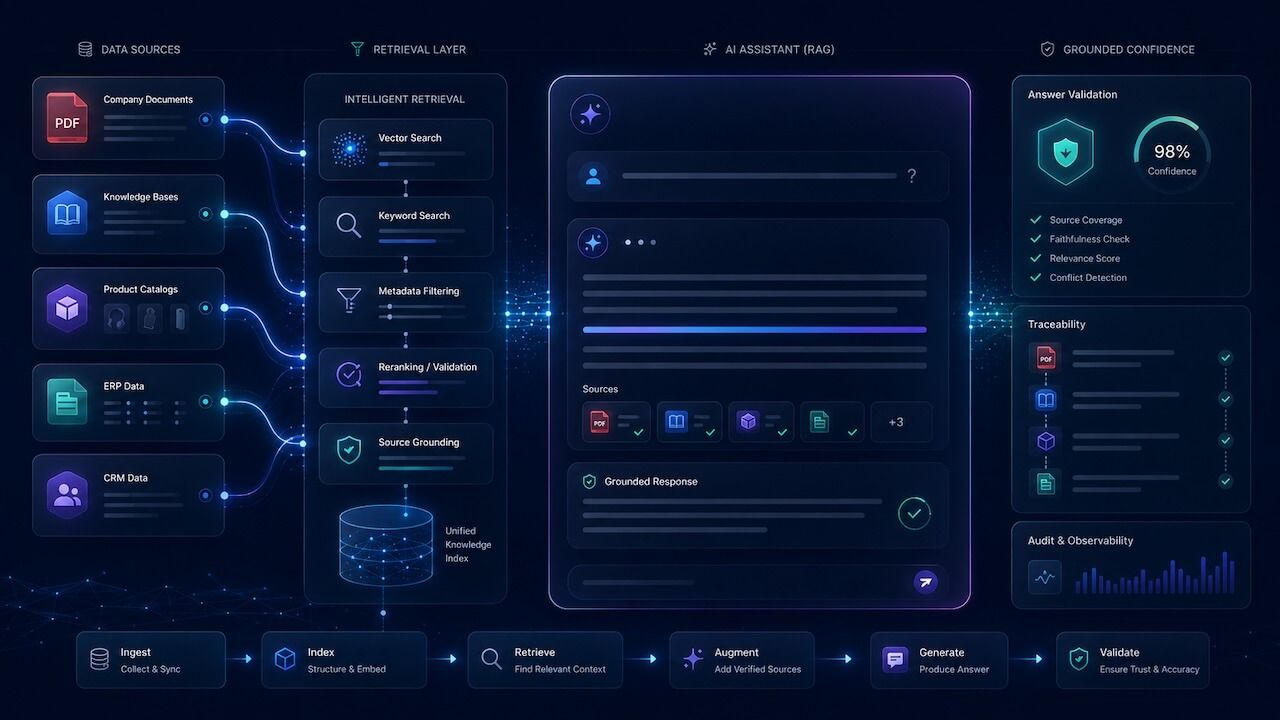
Conversational AI grounded in your company data — documents, knowledge bases, product catalogs, internal wikis and operational data. We design retrieval pipelines that actually return relevant answers, not hallucinated responses.
#LLM Pipelines for Business
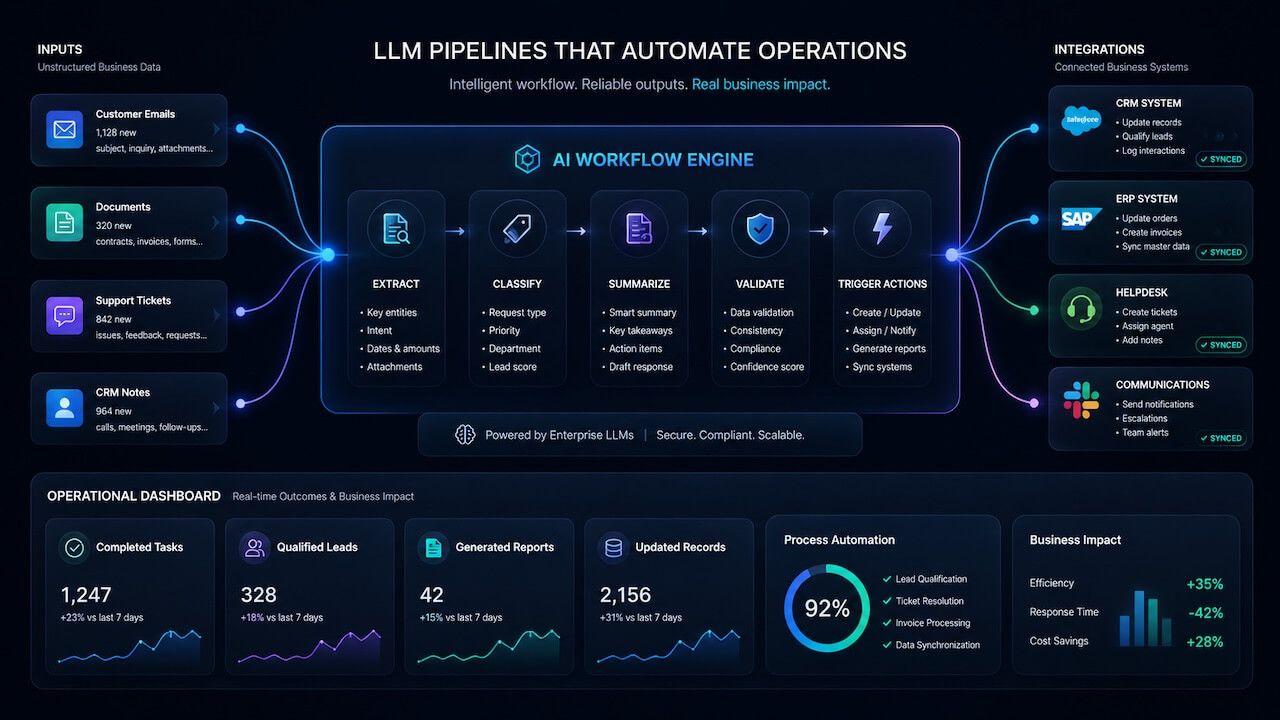
Multi-step processing pipelines: ingestion, chunking, embedding, retrieval, generation, validation and output routing. Built for production environments — not notebook demos. We design pipelines that handle real data volumes, edge cases and failure modes.
#Custom Retrieval & Semantic Search
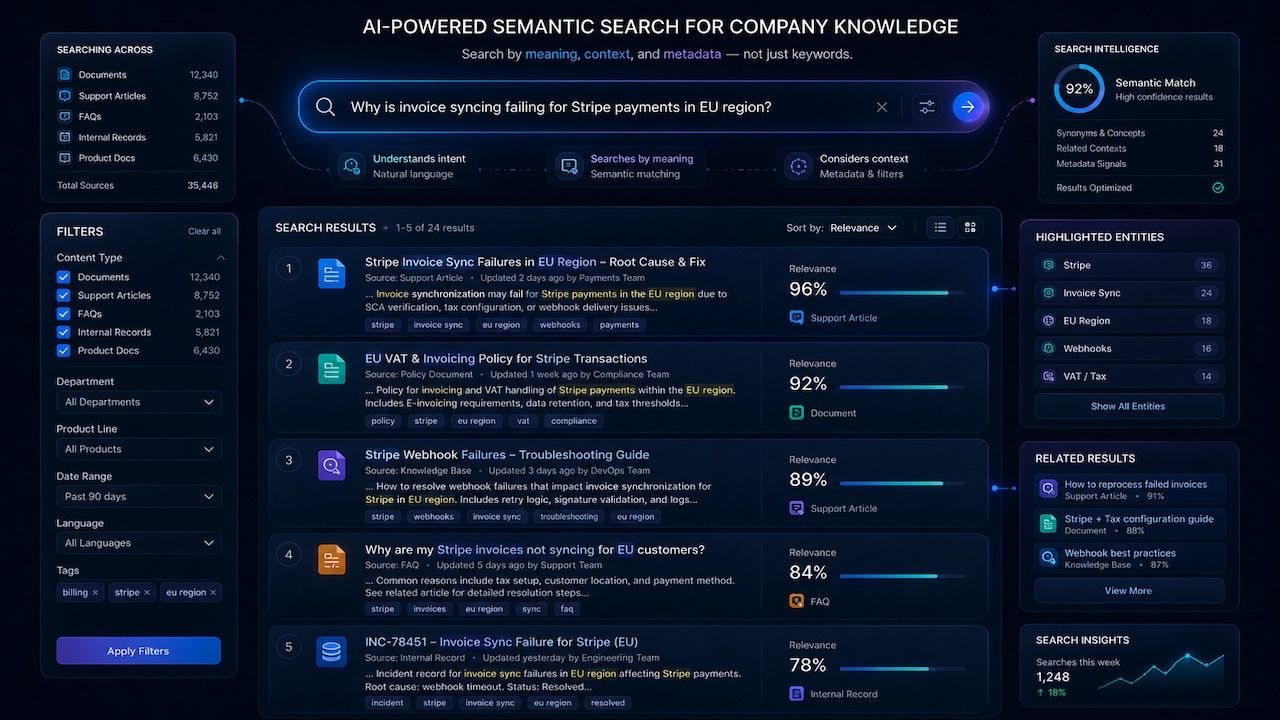
When standard vector search isn't enough — graph-based retrieval, hybrid search, structured data queries combined with LLM generation. We build custom retrieval systems for complex business data models that off-the-shelf RAG frameworks cannot handle.
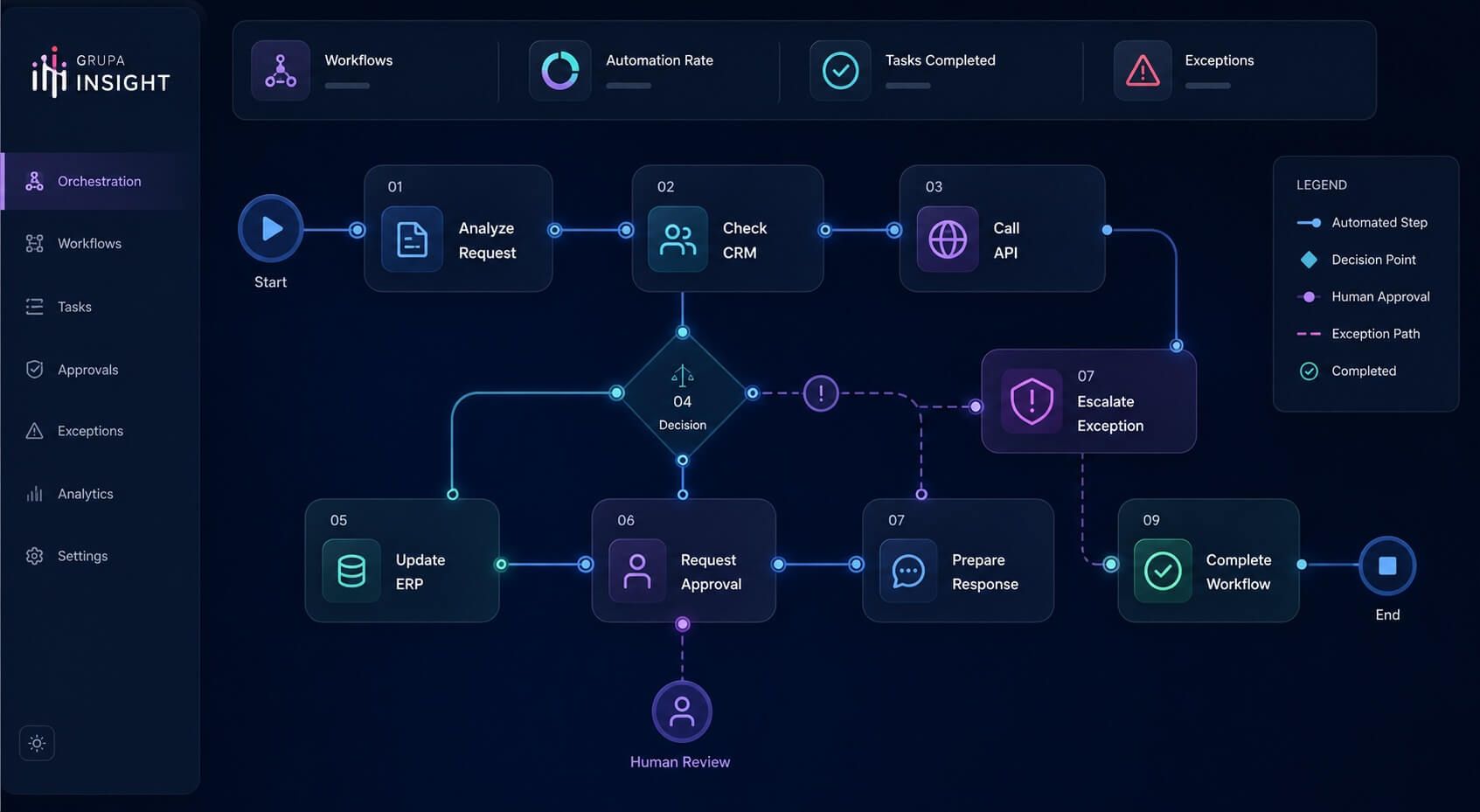
#AI Agents & Process Automation
Autonomous agents that execute multi-step tasks, interact with external APIs and make decisions based on business rules — connected to your existing systems. We build agents that work reliably in production, not just in demos.
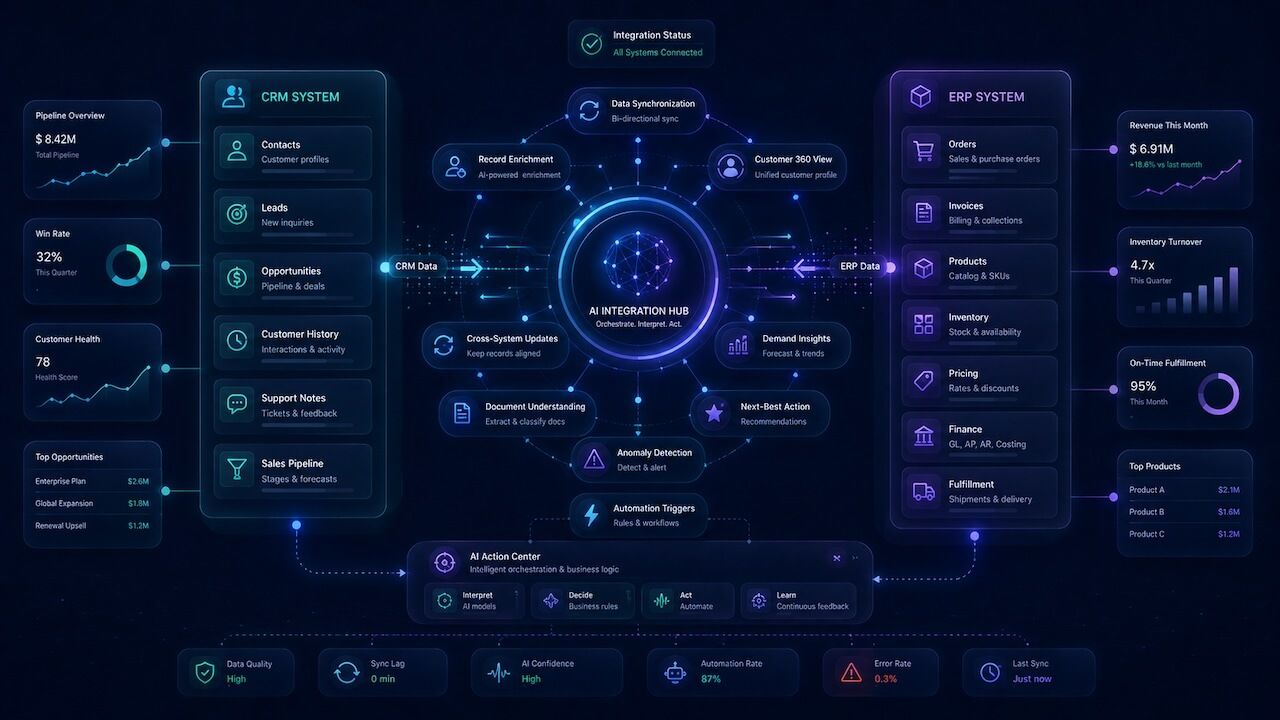
#ERP & CRM AI Integrations
AI layers connected to your existing systems — no full migration required. We integrate LLMs, RAG pipelines and AI agents directly with SAP, Salesforce, custom ERPs, legacy databases and operational tools. Your data stays where it is.
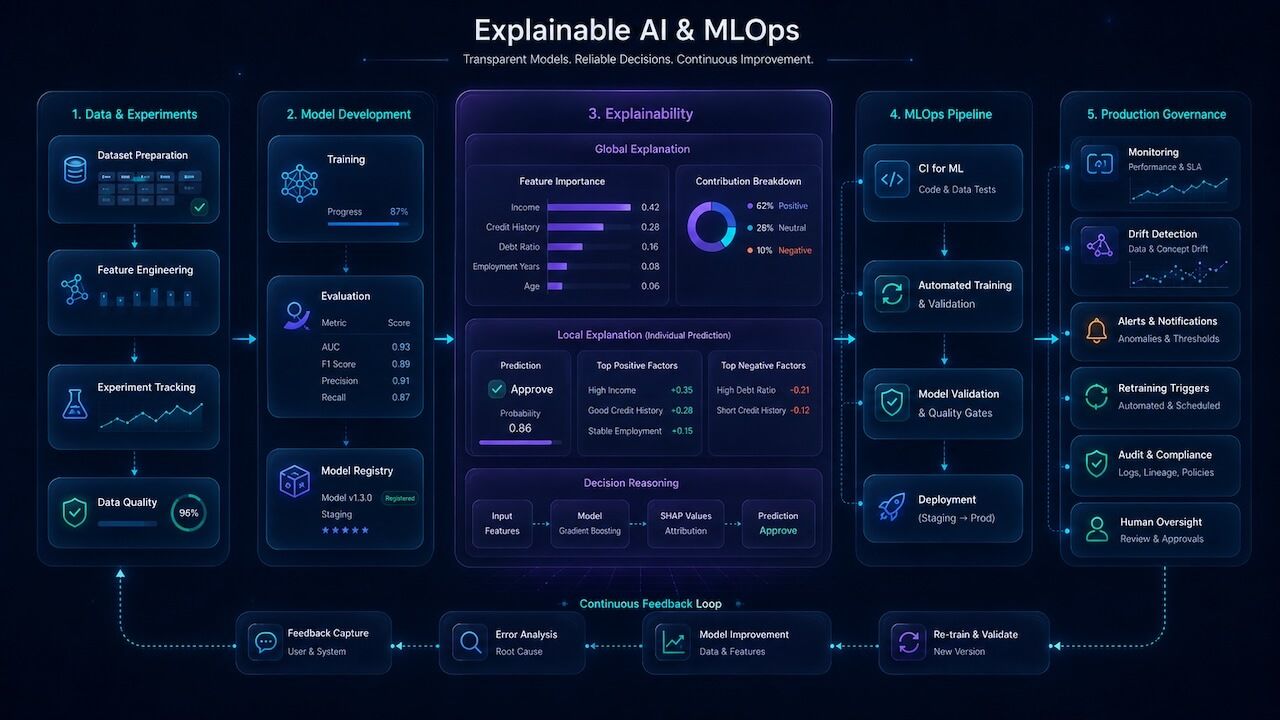
#Explainable AI & MLOp
Auditable AI decisions, model monitoring, drift detection and retraining pipelines — for regulated industries and production environments where black-box systems are not acceptable. Every AI recommendation includes a traceable decision path.
→ LARGE KNOWLEDGE VOLUMES
Documents, PDFs, CRM, ERP, tickets or emails that your team needs to search through manually.
→ REPETITIVE INFORMATION WORK
Your team spends time searching for information or preparing standard responses.
→ PREDICTABLE PROCESS RULES
Processes require classification, data extraction or routing that follows defined rules.
→ LEGACY SYSTEMS, NO FULL MIGRATION
You want an AI layer on top of existing systems without rebuilding everything.
→ REGULATED DECISIONS
You need AI decisions that leave an audit trail and can be explained to regulators.
→ SCALING WITHOUT HEADCOUNT
You want to scale operations without proportionally scaling your team.
Featured AI case study · MLOps · Poultry farming
BLUP-FLOCK ERP
Production AI ERP for pedigree poultry breeding — custom RAG pipeline processing 5-generation genealogical graphs, BLUP algorithm, Explainable AI and full certification auditability. Explainability was a certification requirement, not a nice-to-have.
3-8%
Annual genetic progress
10-25%
Fewer breeders
8
Pipeline layers
READ CASE STUDY →
LLM + RAG · Tourism
VisitZakopane - AI Booking Assistant
Custom LLM chat accepting natural language queries and searching live room availability in real time - without modifying the existing booking system.
Stack: LLM API · real-time data · WordPress
LLM Pipeline · SEO Automation
Automated SEO Audit & Content Generation
Two production LLM systems on DeepSeek API: automated SEO audit generating ready-to-implement reports and a WordPress content pipeline with duplication prevention.
Stack: DeepSeek API · WordPress API · custom pipeline
Data audit before model selection
We assess data quality, structure and retrieval requirements before choosing any technology.
Retrieval design and output validation
Reducing hallucination risk at the architecture level, not after deployment.
Permissions, logs and audit trail
Access controls and full audit trails built into the system from day one.
Human approval for high-stakes decisions
Human-in-the-loop workflows where AI decisions have real business or legal consequences.
Post-launch monitoring and drift detection
We monitor model quality after launch and trigger retraining when performance degrades.
Fallbacks and failure modes
Every system has a defined failure mode — graceful degradation, not silent errors.
Discovery - Data Audit - Architecture - Production Build - Monitoring
Discovery
We map your use case, data sources, integration points and business constraints before choosing any technology.
Data Audit
We assess data quality, structure and retrieval requirements. Most AI projects fail here — we fix it first.
Architecture
Model selection, retrieval strategy, integration layer, security and auditability — designed before any code is written.
Production Build
Iterative development with continuous evaluation. No black-box handoffs — you see every step.
Monitoring
Post-launch monitoring, drift detection, retraining pipelines and ongoing optimization.
#AI Discovery Sprint
Tell us about your AI use case
In 1-2 weeks we map your use case, assess your data, identify integration risks and outline the architecture and budget for your first AI implementation.
We review your data sources, integration points, risks and outline MVP architecture and budget.
What is the difference between RAG and a standard chatbot?+
A standard chatbot generates responses based on its training data — it cannot access your company-specific information and may hallucinate facts. A RAG system retrieves relevant content from your actual data sources in real time and uses it as context for the language model. The result is grounded, accurate responses based on your documents, databases and operational data — not on what the model was trained on.
Do you work with existing ERP and CRM systems?+
Yes — we integrate AI layers directly with your existing systems without requiring a full migration. We connect LLMs, RAG pipelines and AI agents to SAP, Salesforce, Microsoft Dynamics, custom ERPs and legacy databases. Your data stays where it is. We build custom API connectors when native integrations are unavailable.
How long does an AI integration project take?+
It depends on the scope. A focused RAG chatbot on existing documents can be delivered in 4-6 weeks. A full LLM pipeline with ERP integration, custom retrieval and MLOps infrastructure typically takes 3-4 months. We always start with a discovery phase and data audit before committing to a timeline — most delays in AI projects come from underestimating the data preparation layer.
What data formats and sources do you support?+
We work with virtually any data source: PDFs, Word documents, Excel files, HTML content, SQL and NoSQL databases, REST APIs, ERP exports, CRM data, email archives and custom file formats. For unstructured data we build ingestion and preprocessing pipelines. For structured data we build query layers that combine database lookups with LLM generation. If your data exists somewhere, we can build a retrieval layer on top of it.
Do you offer post-launch support and model monitoring?+
Yes. We provide ongoing technical support, model performance monitoring, drift detection and retraining pipelines. AI systems degrade over time as data distributions shift — we build monitoring infrastructure that detects this early and triggers retraining automatically or alerts your team. We build long-term partnerships, not one-off deliveries.
Is explainable AI available for regulated industries?+
Yes — and for regulated industries it is a requirement, not an option. Every AI recommendation in our systems includes a traceable decision path that can be audited by management, compliance teams or external certifiers. We have delivered explainable AI systems in agriculture, legal and financial services. If your industry requires documented AI decisions, we build that auditability into the architecture from day one — not as an afterthought.
How much does an AI integration project cost?+
We don't have fixed pricing packages. Every project is quoted individually based on data complexity, integration scope, infrastructure requirements and ongoing monitoring needs. A focused RAG chatbot on existing documents starts from a different budget than a full MLOps pipeline with ERP integration and custom retrieval. After a discovery call and data audit we prepare a realistic estimate with clear scope and deliverables.
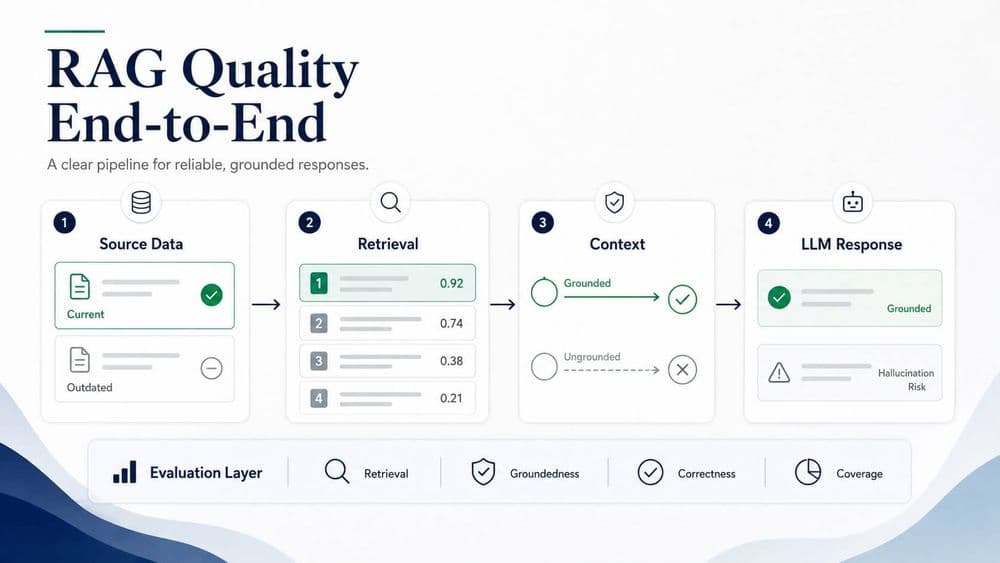
How to Measure RAG Quality and Reduce Hallucinations
How to evaluate RAG quality, diagnose failures and reduce hallucinations.
READ MORE →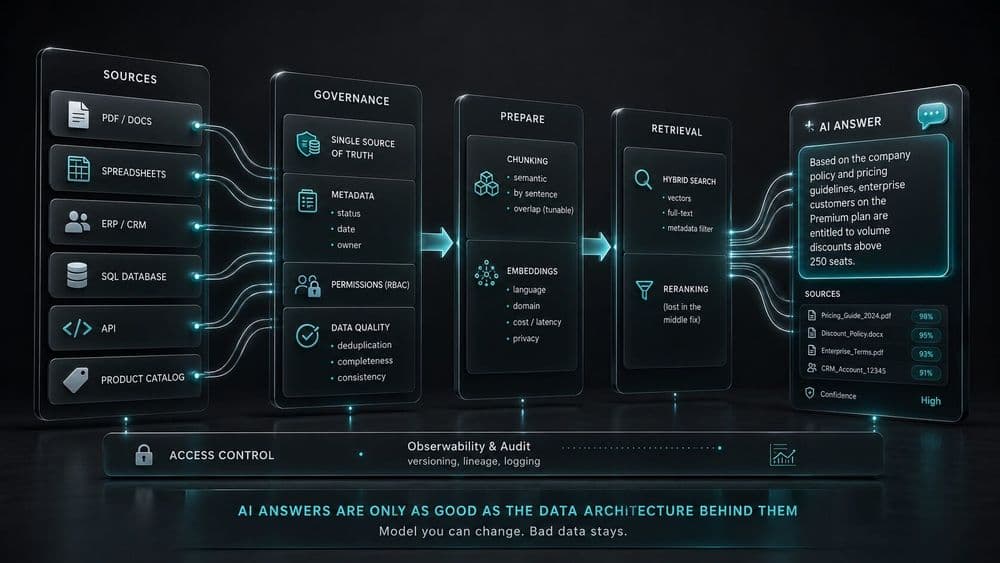
How to Prepare Your Company's Data for a RAG or LLM Deployment
How to Prepare Your Company's Data for RAG or LLM
READ MORE →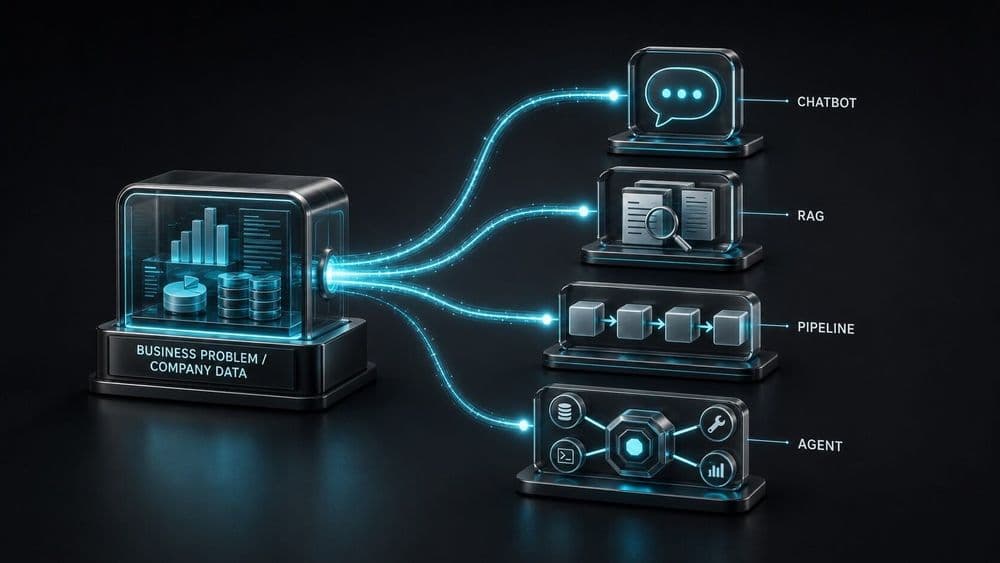
RAG, Chatbot, or AI Agent — What Does Your Company Really Need?
RAG, chatbot or AI agent - what does your company actually need?
READ MORE →