
ChatGPT Search SEO: How to Make Your Website Discoverable, Trusted and Citable in AI Search
Most SEO strategies were built for a world where search meant Google, visibility meant ranking positions, and success was measured by clicks.
That world still exists — but it is no longer the whole search journey.
In 2026, more product research, vendor comparison, and purchase decision-making happens inside conversational AI systems: ChatGPT Search, Perplexity, and Google AI Overviews and AI Mode. These systems do not simply return ten blue links. They answer, summarize, compare, and often cite sources.
That changes the question every brand has to ask.
Not only: "Do we rank on page one?"
But also: "Are we a source an AI system can find, understand, trust, and cite?"
This guide explains how to optimize a website for ChatGPT Search and AI Search in 2026 — without pretending there is a secret ranking formula. There is no guaranteed way to appear in every AI answer. But there are clear, controllable signals that make your website more retrievable, attributable, and quotable across AI search environments.
Those signals are the foundation of AI Search Optimization.
Why AI Search Changes the Search Journey
Many AI search experiences rely on retrieval-based mechanisms: they identify relevant web sources, extract useful passages, and synthesize them into an answer. AI search does not behave like a classic list of ranked search results. Instead, it often selects and summarizes sources that are useful for answering a specific question.
The internal mechanics of each system differ, and none of the major providers publish a complete optimization checklist. What we can say with confidence is that certain properties of content and site architecture make pages more likely to be retrievable, attributable, and quotable — regardless of which AI search system is doing the selecting.
AI Search Optimization is not about manipulating a model. It is about reducing ambiguity for systems that retrieve, summarize, attribute, and cite web information.
What AI Search Optimization Is Not
AI Search optimization is not prompt manipulation. It is not keyword stuffing for language models. It is not a guaranteed way to appear in every ChatGPT, Perplexity, or Google AI Overview response. And it is not a replacement for SEO.
It is a discoverability discipline for a new search environment.
The objective is to make a website easier for AI systems to:
- crawl
- interpret
- attribute
- verify
- summarize
- cite
That requires strong technical SEO, clear content architecture, structured data, entity consistency, source-backed claims, and a measurable visibility baseline.
AI Search optimization is not a shortcut around SEO. It is the next layer on top of it.
What We Know — and What Remains Unclear
No major AI search provider publishes a complete ranking or citation formula. ChatGPT Search, Perplexity, and Google AI Overviews and AI Mode use different systems, indexes, crawlers, models, and citation behaviours.
That means AI Search Optimization should not be presented as reverse-engineering a single algorithm.
What we can verify from official documentation is narrower, but still strategically important:
- OpenAI uses
OAI-SearchBotto surface websites in ChatGPT search features, and separates this fromGPTBot, which relates to potential model training access. These are independent settings inrobots.txt. - Google states that the same SEO fundamentals remain relevant for AI Overviews and AI Mode, and that there are no additional technical requirements or special schema.org markup needed to appear in these features.
- Perplexity states that
PerplexityBotrespectsrobots.txtand that blocked content is not indexed or used for pre-training foundation models. llms.txtis a proposed standard described by its authors as a proposal to standardise a file that helps LLMs use website information — not a confirmed universal requirement.
What remains unclear is the exact weighting of signals, how citation selection changes by query type, how personalization or freshness affects source selection, and whether entity graph data plays a direct role. The right strategy is not to chase hidden ranking factors. The right strategy is to reduce ambiguity.
The Grupa Insight AI Search Readiness Framework
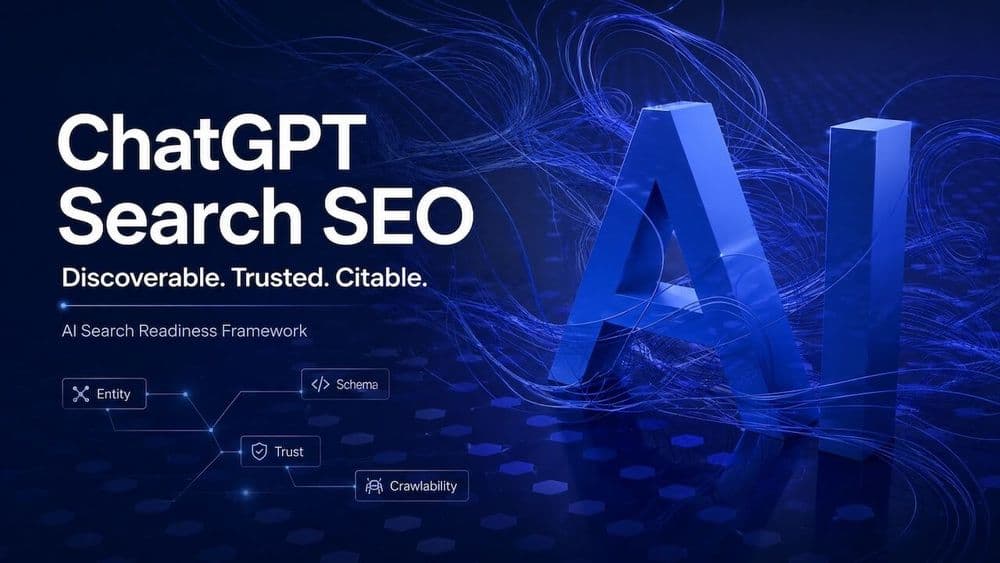
At Grupa Insight, we evaluate AI Search readiness across six dimensions: entity clarity, content architecture, structured data, topical authority, trust signals, and crawler accessibility.
Together, these determine whether a website is merely published — or actually usable as a source by AI search systems.
1. Entity Definition — Be Knowable Before Being Findable
The first question an AI system asks about your brand is not "how does this rank?" but "what is this?"
An entity is a named, structured piece of knowledge: a company, a person, a service, a location. If your brand is not consistently defined across your own website and trusted external sources, AI systems have less context for understanding who you are, what you do, and whether your content should be attributed to you.
For a professional services company, entity clarity means that the same company name, service categories, locations, leadership profiles, author names, and external profiles tell one consistent story. If your website says one thing, your LinkedIn page says another, and your directory profiles use outdated descriptions, the entity becomes noisy.
What to do:
- Create a dedicated About page that defines your company in factual terms: what you do, who you serve, where you operate, when you were founded. Write it the way a Wikipedia editor would — declarative, sourced, unambiguous.
- Ensure your name, address, phone number (NAP), and core services are consistent across your website, Google Business Profile, LinkedIn, Clutch, and relevant industry directories.
- Use
Organizationschema withsameAslinks to all verified profiles. - Build a named author page for every person who publishes content on your site — with role, years of experience, and links to their external presence.
At Grupa Insight, we treat entity definition as the foundation of every AI Search project. We explored the mechanics of entity-based visibility in depth in Entity SEO in 2026: Why Brands Win Over Keywords. The fastest visibility gains we have seen came not from content volume but from making the brand recognizably consistent across web sources.
2. Content Architecture — Structure That AI Can Parse
Well-structured content is easier for AI systems to parse, extract, summarize, and cite than prose-heavy or visually complex pages.
A short page packed with target phrases gives an AI system very little context to work with. A more complete page that defines a concept, explains its mechanism, compares alternatives, and answers follow-up questions is usually easier to retrieve and summarize.
The most useful content formats:
- Definition paragraphs — a short, direct answer to "what is X" at the opening of every section. Write the sentence the model might quote verbatim. Front-load the conclusion; elaboration follows.
- Numbered or bulleted processes — step-by-step formats with clear headings are easily extracted. "How to migrate a WooCommerce store to Headless Next.js in 5 steps" is more retrievable than an essay on the same topic.
- FAQ sections with real questions — not "What makes you different?" but "How long does an AI SEO implementation take?" FAQ structured with FAQPage schema gives the system both the question and a quotable answer in a single, self-contained unit.
- Comparison tables — structured comparisons are easy to extract and summarize. If your service category involves options or trade-offs, a clear table outperforms narrative.
What to avoid:
- Burying key information in PDFs, JavaScript-rendered components, or behind login gates
- Vague section headings that do not telegraph the content below
- Walls of text without subheadings, definitions, or structural cues
A useful test: can you extract a complete, standalone answer to a specific question from each section of your page in under 60 words? If not, the section is under-structured for AI retrieval.
3. Schema Markup — Make Pages Self-Describing
Structured data does not directly cause AI citations. But it gives systems unambiguous signals about what a page is, who created it, and what it describes — reducing interpretive load and increasing the probability of correct attribution.
For Google AI Overviews and AI Mode specifically, Google states that there is no special schema.org markup required to appear in these features. Structured data should not be treated as an AI shortcut. Its role is more fundamental: it helps make page meaning, authorship, dates, organization, breadcrumbs, products, services, and FAQs machine-readable — as long as it matches the visible content on the page.
Minimum viable schema for AI Search readiness:
Organization— on the homepage and About page, withname,url,logo,sameAs,contactPointWebPage/Article— on every content page, withauthor,datePublished,dateModifiedPerson— on every author bio page, linking back to published articlesFAQPage— on service pages and long-form articles with Q&A sectionsBreadcrumbList— sitewide
For service businesses: add LocalBusiness or ProfessionalService, Service on individual service pages, and Review if you have aggregated ratings.
The goal is not to accumulate schema types. For a deeper look at how structured data works across AI Search environments, see Structured Data in the Era of AI Search. The goal is to make every important page self-describing — so a system can answer "who published this, when, and on what topic" without parsing prose.
4. Topical Authority — Own a Category, Not Just a Keyword
In practice, isolated pages are rarely enough to build durable visibility. A single article can answer one question, but a content cluster gives both users and machines more context: definitions, comparisons, implementation guides, FAQs, case studies, and service pages connected around one category.
For example, an AI Search Optimization cluster should not consist of one article called "AI SEO." It should include a strategic framework, a technical guide, an entity SEO article, a structured data article, a measurement guide, industry use cases, and a service page that explains how the work is delivered.
How to build topical authority for AI Search:
- Map a content cluster around your core service category — 5 to 10 pieces minimum
- Cross-link within the cluster using descriptive anchor text, not "click here" or "read more"
- Publish at a consistent cadence — a cluster last updated in 2022 signals stagnation regardless of its original quality
- Use internal links that reinforce entity relationships: author → article, service → case study, FAQ → article
The Grupa Insight content strategy for AI Search is built entirely around clusters. The articles published in Q1 and Q2 2026 — on structured data, entity SEO, and AI Search measurement — form a single retrievable cluster that reinforces a consistent brand position across related topics. No article is designed to stand alone.
5. Trust Signals — Prove That an Expert Stands Behind the Content
E-E-A-T comes from Google's Search Quality Rater Guidelines. It should not be described as a direct ranking factor or a confirmed AI citation signal. But it is a useful framework for evaluating whether content is easy to trust, verify, and attribute.
For AI Search, the same logic applies: a page with a named author, clear editorial responsibility, current sources, transparent dates, and verifiable expertise is easier to evaluate than anonymous, unsupported content — for users and systems alike.
Practical checklist:
- Every article has a named author with a linked bio
- Author bios list credentials, years of experience, and links to external presence (LinkedIn, published interviews, conference talks)
- Articles reference named sources, tools, and data — not vague "studies show" or "experts agree"
- A clear editorial note explains the basis for claims and when the article was last updated
- The site has been cited or linked by recognizable external sources in the industry
In our own implementation work, we often see stronger visibility patterns when a brand combines clear entity signals with a focused content cluster. This should be treated as an observed pattern, not a public ranking rule: content quality matters, but content alone is rarely enough when the brand behind it is difficult to identify, verify, or attribute.
6. Technical Accessibility — Make Your Content Reachable for AI Search Systems
AI search visibility starts with access. If a system cannot crawl, fetch, or interpret your content, it cannot reliably cite it.
But not every AI crawler has the same purpose.
OpenAI separates search crawling from model-training crawling. OAI-SearchBot is associated with search-related discovery and citation in ChatGPT Search, while GPTBot is controlled separately for potential model training access. That distinction matters: allowing your content to appear in AI search and allowing your content to be used for model training are not the same strategic decision.
Perplexity's documentation states that PerplexityBot respects robots.txt and that blocked content is not indexed or used for pre-training foundation models.
Technical audit checklist:
- Check
robots.txtand confirm thatOAI-SearchBotandPerplexityBotare not blocked if AI search visibility is your goal - Evaluate
GPTBotseparately if your organization has a policy on model-training access - Verify that core content is available as indexable HTML, not hidden behind JavaScript-heavy interfaces, login walls, or inaccessible components
- Ensure canonical URLs are clean and consistent — duplicate or conflicting URLs create retrieval ambiguity
- Monitor Core Web Vitals and page experience — performance still matters because technical SEO, crawlability, and user experience remain part of the wider discoverability layer
- Consider implementing
llms.txtas an experimental AI-readiness layer — there is currently no verified public evidence that it is a universal requirement for visibility in ChatGPT Search, Google AI Overviews, or Perplexity. It is best deployed alongsiderobots.txt,sitemap.xml, schema markup, and strong internal linking — not as a replacement for them
What Makes Content More Useful for AI Search — and What Usually Adds Little Value
More useful:
- Clear, declarative sentences at the start of sections
- Named authors with verifiable credentials
- Consistent brand entity presence across the web
- Topical depth and breadth over surface-level coverage
- Structured data that matches visible content
- Fresh, regularly updated content with explicit publication and modification dates
- Source-backed claims, examples, and implementation details
Usually low-value:
- Keyword frequency and keyword density
- Meta keywords
- Low-quality backlinks from irrelevant domains
- Decorative subheadings that do not explain the section
- Content hidden in carousels, tabs, or JavaScript-dependent components
- Anonymous or unattributed publishing
- Generic AI-generated content with no original experience, examples, or evidence
The Role of Original Experience
AI Search systems do not need another generic explanation of the same topic. They need sources that add something specific: implementation details, tested workflows, real examples, data, case studies, or expert interpretation.
For a service business, original experience can appear in several forms:
- before-and-after implementation examples
- screenshots from audits or analytics reports
- anonymized client patterns
- technical decisions and trade-offs
- mistakes discovered during real projects
- practical checklists used by the delivery team
This is where expert content becomes difficult to copy. Definitions can be rewritten by anyone. Original experience cannot.
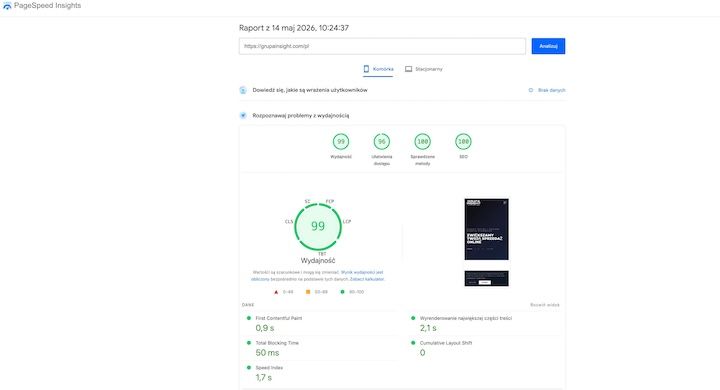
Grupa Insight's own website scores 99/100 in PageSpeed Insights on mobile, with LCP at 2.1s and CLS at 0 in the captured test. We do not present this as an AI ranking signal. We present it as evidence that the same technical standards we recommend to clients are implemented on our own website.
[Screenshot: PageSpeed Insights — grupainsight.com, mobile, Performance 99 / Accessibility 96 / Best Practices 100 / SEO 100, May 2026]
How to Check Whether AI Search Can Actually See Your Brand
AI Search measurement is imperfect — and that is exactly why you need a baseline.
Unlike classic SEO, AI Search does not give you stable ranking positions, clean impression data, or a universal analytics dashboard. The same query can produce different answers depending on context, location, personalization, freshness, and the system used.
That does not mean measurement is impossible. It means you need to measure visibility patterns rather than fixed positions.
Four things to check right now:
- Referral traffic from chatgpt.com — open your analytics platform and filter referral sources. OpenAI states that publishers who allow
OAI-SearchBotcan track referral traffic from ChatGPT because ChatGPT automatically includesutm_source=chatgpt.comin referral URLs. - Branded query trends in Google Search Console — filter impressions and clicks for your brand name. A rising trend in branded queries often indicates growing brand-level awareness, which AI-driven exposure can contribute to even when no click is recorded.
- Monthly prompt tests — run a consistent set of queries across ChatGPT, Perplexity, and Google Search queries that may trigger AI Overviews each month. Test your brand name, your core services, and competitive comparisons. Document whether you appear, who is cited instead, and what sources the AI references.
- Source attribution check — when you do appear in AI answers, note whether the system is citing your own pages, third-party mentions of your brand (directories, press, reviews), or neither. This tells you whether your owned content or your entity footprint is doing the work.
Track these monthly. For a complete measurement framework, see How to Measure AI Search Visibility in 2026. The goal is a simple visibility baseline — not a complex dashboard — that tells you whether your optimization efforts are moving the needle.
A Practical Roadmap: The First 90 Days
Days 1–30 — Make the Site Accessible and Attributable
- Audit
robots.txt, CDN rules, and WAF settings for search-related AI crawlers such asOAI-SearchBotandPerplexityBot - Evaluate
GPTBotseparately if your organization has a policy on model-training access - Verify that key service, article, case study, and author pages are available as indexable HTML
- Implement or clean up
Organization,Person,Article,WebPage,BreadcrumbList, and relevantServiceschema - Update author attribution, publication dates, and editorial notes
- Create an initial AI visibility baseline using branded prompts, service prompts, and referral traffic checks
Days 31–60 — Build Entity and Content Clarity
- Rewrite key service pages with direct definition paragraphs, use cases, process sections, FAQs, and comparison blocks
- Create or improve About, author, service, and case study pages
- Align company descriptions across LinkedIn, Google Business Profile, directories, partner profiles, and industry databases
- Publish or update one pillar article in the AI Search cluster
- Add internal links between services, articles, case studies, and author pages
Days 61–90 — Build Topical Authority and Measurement
- Publish supporting articles around the main category: entity SEO, structured data, AI visibility measurement, ChatGPT Search, Google AI Overviews, and industry-specific use cases
- Run monthly visibility tests across ChatGPT, Perplexity, and Google Search queries that may trigger AI Overviews or AI Mode responses
- Compare cited sources against your own pages and third-party mentions
- Use analytics, GSC, and manual prompt testing to identify whether visibility is improving
- Turn the findings into an AI Search Readiness report and implementation backlog — the full measurement methodology is covered in How to Measure AI Search Visibility in 2026
The Competitive Window Is Still Open
AI Search optimization is still an immature discipline. Many agencies talk about GEO or LLM SEO, but few brands have completed a serious audit of entity clarity, AI crawler access, structured data, content architecture, and AI visibility measurement.
That gap will close. Brands that build entity presence, structured content, and topical authority now will carry that advantage forward as AI Search grows its share of total queries.
The technical foundation is not complex. The content investment is not large. What it requires is a clear framework and consistent execution — and starting before the window narrows.
Want to Know Whether Your Brand Is Visible in AI Search?
Grupa Insight runs AI Search Readiness audits for brands that want to understand whether their websites are discoverable, attributable, and citable across ChatGPT Search, Google AI Overviews and AI Mode, Perplexity, and other AI search environments.
The audit covers entity clarity, structured data, content architecture, crawler accessibility, trust signals, AI visibility testing, and a prioritized implementation roadmap.
See what AI Search Optimization looks like in practice →
Frequently Asked Questions
Can you guarantee visibility in ChatGPT Search? No. There is no public mechanism that guarantees inclusion or citation in ChatGPT Search. AI Search optimization improves the probability that your content can be discovered, interpreted, trusted, and cited when relevant — but no agency can honestly guarantee appearance in every AI answer.
Should I allow GPTBot if I want to appear in ChatGPT Search?
Not necessarily. OpenAI separates OAI-SearchBot, which is associated with search discovery in ChatGPT Search, from GPTBot, which relates to potential model training access. If your goal is ChatGPT Search visibility, evaluate OAI-SearchBot first. Decide on GPTBot separately based on your organization's policy toward training data access.
Is llms.txt required for AI Search?
No. llms.txt is not a confirmed universal requirement for AI Search visibility. It is best treated as an experimental support file that helps describe your most authoritative content. It should be implemented alongside stronger fundamentals: crawlability, sitemap.xml, schema markup, internal links, and clear content architecture — not as a replacement for them.
Is AI Search Optimization different from SEO? Yes, but it is not separate from SEO. AI Search Optimization builds on technical SEO, structured content, crawlability, internal linking, page experience, and helpful content. The difference is the emphasis: AI Search requires stronger entity clarity, source attribution, content structure, and retrievability because systems often summarize and cite passages rather than simply ranking pages in a list.
How do you measure AI Search visibility? AI Search visibility is measured through a combination of referral traffic analysis, source attribution checks, branded and non-branded prompt testing, Google Search Console trends, and citation monitoring across ChatGPT, Perplexity, and Google AI Overviews. It is not as clean as classic rank tracking, so the goal is to measure visibility patterns over time rather than fixed positions.
Does ChatGPT Search use the same signals as Google? There is meaningful overlap — quality content, clear structure, and authoritativeness matter in both systems — but the mechanisms differ. Classic search ranks pages in a list; AI search selects and summarizes sources useful for answering a specific question. Schema markup, entity consistency, and content clarity appear to matter more in AI Search than raw link authority, though the exact weighting is not publicly documented.
Can a small website be cited in ChatGPT Search? Yes, but not because size stops mattering. A smaller website can become useful as a source when it covers a specific topic clearly, provides original experience, is technically accessible, and presents strong entity and trust signals. In niche B2B or professional services categories, depth and specificity can help a smaller site compete with broader, less focused sources.
Sources
- OpenAI — Bots and Crawlers Documentation: documentation on
OAI-SearchBot,GPTBot, and independent robots.txt controls for search visibility and model-training access. platform.openai.com/docs/bots - OpenAI — Publishers and Developers FAQ: guidance on appearing in ChatGPT search results and tracking referral traffic from ChatGPT via
utm_source=chatgpt.com. help.openai.com - Google Search Central — AI Features and Your Website: guidance on AI Overviews, AI Mode, SEO fundamentals, technical eligibility, structured data, and Search Console reporting. developers.google.com
- Google Search Central — Creating Helpful, Reliable, People-First Content: guidance on helpful content and E-E-A-T as used in Search Quality Rater Guidelines. developers.google.com
- Perplexity — How does Perplexity follow robots.txt?: guidance on
PerplexityBot, robots.txt handling, indexing limitations for blocked pages, and model-training concerns. perplexity.ai - llms.txt — The /llms.txt File: original proposal to standardise an LLM-readable website guidance file. llmstxt.org
This article was written by the SEO & AI team at Grupa Insight based on practical implementation work across client engagements and the agency's own AI Readiness deployments. Technical claims reflect observed patterns and publicly available documentation from OpenAI, Google, and Perplexity as of Q2 2026. Where official documentation is cited, links are provided in the Sources section. The llms.txt specification is described by its authors as a proposal to standardise. Last updated: May 2026.
— Editorial & Sources Policy